 By
By 
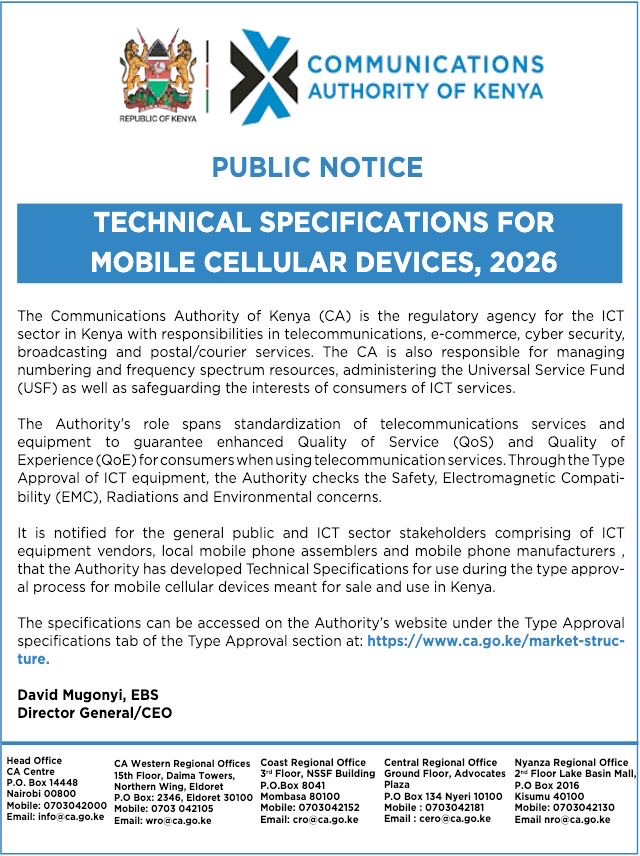
The Communications Authority issued a public notice yesterday ( March 24, 2026) announcing updated Technical Specifications for Mobile Cellular Devices that will govern which phones can legally be sold and used in Kenya going forward. The notice, signed by Director General David Mugonyi, targets ICT equipment vendors, local assemblers, and manufacturers, and arrives one month after the CA banned 21 phone brands outright for failing to meet type approval standards.
The timing is not coincidental. In the same week, the CA proposed new permit processing fees for ICT imports through KenTrade. That proposal, which we covered separately, adds a Ksh 15,000 per-permit fee on commercial imports and Ksh 5,000 on personal imports. Together, the two moves form a coherent regulatory tightening: stricter standards for what devices qualify, and higher fees for bringing them in. The combined effect on Kenya's phone market (particularly at the affordable end) deserves a careful look.
What the CA Is Actually Requiring
The 2026 Technical Specifications set out the minimum standards every mobile device must satisfy before receiving type approval, the CA's mandatory certification that a device meets Kenya's technical, safety, and network compatibility requirements. No type approval means no legal sale, and increasingly, no network access.
The twelve core requirements cover:
Identification. Every device must carry a valid 15-digit IMEI number issued by the GSMA, the global body that manages mobile identity standards. The IMEI must be permanently printed on the handset, legible and indelible, and accessible by dialling \*#06#. Devices with cloned, spoofed, or duplicate IMEIs are immediately disqualified.
Network compatibility. Devices must support the frequency bands used on Kenyan networks — GSM 900/1800 for 2G, UTRA FDD for 3G, and E-UTRA (LTE) for 4G. Compliance with ETSI EN 301 511 and ETSI EN 301 908 standards is required. A phone that supports global LTE bands but omits the specific bands Safaricom, Airtel, or Telkom use in Kenya fails this requirement regardless of how capable it is on its home network
Radiation safety. Phones must comply with a Specific Absorption Rate (SAR) limit of no more than 2 W/kg averaged over 10 grams of tissue, the international standard used across the EU and most of Africa. SAR measures how much electromagnetic energy a device transmits into the human body during a call.
Electrical and safety standards. Chargers and adaptors must meet national standards and align with ITU-T L.1000 specifications for 240V operation, Kenya's mains voltage. Devices must meet thresholds for overheating, short circuits, and mechanical risks.
Labelling. Devices must display durable labels showing model name, IMEI, supported frequency bands, supplier information, and CA type approval details. Safety guidance on radiation exposure must appear in the user manual or on packaging.
Functionality. All devices must support voice calls and SMS as a baseline. 3G and 4G models must additionally support data and internet services. Keypads must follow ITU-T E.161 layout standards, and an earpiece option ( wired or Bluetooth-compliant ) must be available.
The full specifications document is available at ca.go.ke under the Type Approval section.
The 21 Brands Already Banned
The March 24 specifications notice follows a February 10 enforcement action that is worth understanding in context.
On February 10, 2026, the CA released a list of 21 phone brands already circulating in Kenya that it ordered off the market immediately for failing type approval. The banned brands include TINSIK, FONROX, QQMEE, MOMOFLY, and 17 others , primarily no-name Chinese-manufactured devices that entered the Kenyan market through informal import channels.
These are not brands most Kenyans will recognise from legitimate retail. They represent the bottom tier of Kenya's grey market, devices assembled at minimal cost, with no safety testing, no IMEI compliance, and no network optimisation for Kenyan frequencies. The CA's case for removing them is straightforward: a phone that poses a fire risk, emits radiation above safe limits, or disrupts network signals creates real harm regardless of how cheaply it is priced.
What matters for the broader market is the enforcement mechanism the CA is putting in place to make these bans stick because listing banned brands in a notice is very different from actually keeping them off the streets.
The IMEI Whitelist: The Real Enforcement Tool
The most powerful enforcement mechanism in the CA's compliance framework is not a fine or a confiscation notice. It is the IMEI whitelist, the database of approved device identifiers that determines which phones can connect to Kenyan networks at all.
A device that cannot connect to any Kenyan network is effectively a brick. If the CA's IMEI whitelist is enforced at the network level ( as it increasingly is ) a banned phone that a trader imports and sells becomes unsellable the moment a buyer tries to insert a SIM card. No Safaricom signal. No Airtel data. No network, regardless of the price paid.
This is the strongest deterrent available to the CA and it does not require physical enforcement at every market stall or border crossing. It requires cooperation from the three major network operators ( Safaricom, Airtel, and Telkom ) to block SIM registration and network access for non-whitelisted IMEIs.
The challenge, as the CA itself implicitly acknowledges, is that this pressure has historically pushed traders toward phones with cloned or spoofed IMEIs rather than out of the trade altogether. A device with a spoofed IMEI that matches a whitelisted model passes the network check until the duplicate is detected. Without enforcement that reaches open-air markets and border towns, these rules are most keenly felt by legitimate vendors and least felt by the ones they are meant to stop.
The Two-Stamp System: CA Approval Plus KRA Clearance
What is taking shape in 2026 is a system where two independent stamps of approval are required to legally sell a phone in Kenya.
The first stamp is CA type approval , confirming the device meets technical, safety, and network standards. Processing time is four to eight weeks. Documentation required includes a filled application form, a letter of agency from the manufacturer or authorised distributor, a working sample of the device, technical and user manuals in English, EMC, SAR, and RF test reports from an ISO/IEC 17025 accredited laboratory, and a declaration of conformity.
The second stamp is KRA import clearance, covering customs duties, the import declaration form, and now the proposed Ksh 15,000 permit processing fee through the KenTrade system that the CA proposed separately this month.
Miss either stamp and the phone cannot legally connect to a Kenyan network. For large manufacturers with established CA relationships and pre-approved device portfolios ( Samsung, Tecno, Infinix, Xiaomi ) this is a known and manageable process. For a small importer bringing in a new brand for the first time, the four to eight week type approval timeline, the laboratory testing costs, the documentation requirements, and now the permit processing fee create a compliance barrier that will price some players out of the market entirely.
The Grey Market Question: What Happens to Your OnePlus?
This is where the story gets personal for a segment of Kenyan buyers who know what they want and import it themselves, enthusiast phones, flagship killers, and devices that are simply not stocked by local retailers.
A OnePlus Nord 5, for example, has no official distribution in Kenya. OnePlus does not submit devices for CA type approval in Kenya because the commercial volumes do not justify the compliance investment. The same applies to Google Pixel phones, many Motorola models, certain Sony Xperia variants, and a long tail of devices that are highly regarded in global tech communities but have zero official Kenyan retail presence.
Under the CA's framework, these phones are technically non-type-approved for Kenya, not because they are unsafe or poorly made, but because their manufacturers have not gone through the CA process. A OnePlus Nord 5 almost certainly meets every technical requirement the CA specifies (valid IMEI, correct SAR levels, proper frequency band support) but it does not have the CA certificate because OnePlus has not applied for one.
The practical question is: does this matter for the individual buyer who imports one for personal use?
Currently, the answer is mostly no. The CA's enforcement focus is on commercial vendors selling non-approved devices at scale, not on individuals who import a single phone for personal use. Your OnePlus will connect to Safaricom's network because its IMEI is a legitimate GSMA-issued identifier, it is not in the banned list, it is simply not in the approved list. Kenyan networks do not currently block all non-whitelisted IMEIs, they block specifically flagged ones.
That position could change. If the CA moves toward a stricter IMEI whitelist model (where only approved IMEIs connect rather than only banned IMEIs being blocked ) the implications for grey market imports become significantly more serious. That shift has not been announced, but the trajectory of CA policy in 2026 is toward tighter control, not less.
For now, the practical advice for enthusiast buyers is: import for personal use with awareness that the regulatory environment is tightening. Do not resell. Do not buy in bulk. And watch the IMEI whitelist policy developments carefully over the next 12 months.
What This Means for Budget Buyers
The concern most relevant to ordinary Kenyan consumers is not about OnePlus phones, it is about whether the tightening compliance environment will push up the prices of the affordable devices that most Kenyans actually buy.
The honest answer is: probably yes, at the very bottom of the market, but not dramatically for devices from legitimate brands.
The phones most likely to disappear are exactly the ones the CA is targeting, the TINSIK and QQMEE tier, devices with no verifiable safety credentials, unreliable network performance, and short lifespans. Removing those from the market is a legitimate consumer protection outcome. A Ksh 3,000 phone that overheats, disrupts network signals, and dies in six months is not a bargain for the buyer who cannot afford a replacement.
The phones that Kenyans at the Ksh 10,000 to Ksh 20,000 price range actually buy (Tecno Spark series, Infinix Hot series, Itel A series, Xiaomi Redmi entry-level ) are already type-approved because their manufacturers have formal Kenyan distribution and submit devices for approval routinely. These will not be affected by the new specifications in any meaningful way.
Where the compliance costs may push prices modestly upward is for smaller importers bringing in lesser-known Chinese brands that are legitimate but not type-approved. If those importers have to absorb four to eight weeks of type approval processing, laboratory testing fees, and now the proposed Ksh 15,000 KenTrade permit fee before they can sell, some of them will pass those costs to consumers. Others will exit the market. The range of options at Ksh 5,000 to Ksh 8,000 may narrow, and the prices of what remains may creep upward.
The Bigger Picture: A
CA on the Move
This is the third significant CA action in one month. The ICT import permit fee proposal on March 3. The mobile device specifications notice on March 24. And embedded in the specifications notice, the continuing enforcement of the February 10 brand ban.
The pattern is consistent: the CA is systematically building a more controlled regulatory environment for Kenya's ICT hardware market, higher compliance standards, more structured import processes, stricter enforcement of type approval. Each individual measure has a legitimate rationale. Together, they represent a meaningful increase in the barrier to entry for anyone importing or selling devices in Kenya.
The intended beneficiary is the consumer, safer devices, better network performance, less fraud. The unintended risk is a less competitive market where the compliance burden favours large established players and prices out the smaller importers whose presence keeps prices honest.
Whether the CA's enforcement infrastructure is capable of delivering the consumer protection benefits without the market concentration risk is the question that the next twelve months will answer.
Buying or importing a phone? Check the CA's approved device list at ca.go.ke under the Type Approval section before purchasing. For the full picture on the CA's proposed ICT import permit fees, read our earlier coverage here.
Comments