 By
By 
The instant fines story has a new and final chapter, at least for now.
On Friday March 27, the National Transport and Safety Authority issued a formal notice withdrawing the public announcement that launched the Instant Fines Traffic Management System on March 9. NTSA said the withdrawal was necessitated by the realisation that the public needs to understand the details and standard procedure of handling minor traffic offences as defined in Section 117 of the Traffic Act.
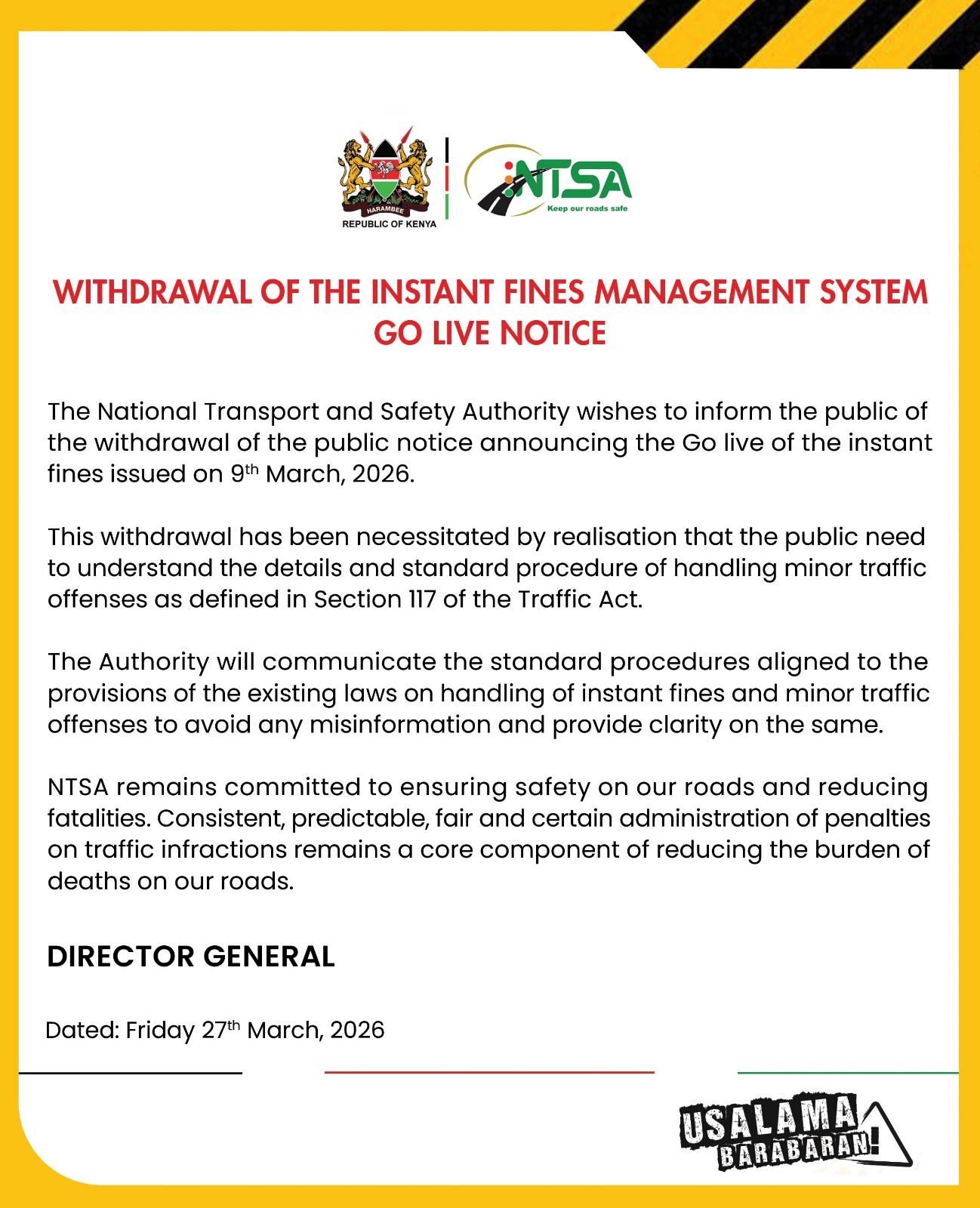
This is a separate and more complete retreat than the High Court suspension we covered on March 12. That suspension was a judicial order, external, imposed by the courts after a constitutional challenge filed by lawyer Shadrack Wambui. This withdrawal is NTSA itself, voluntarily pulling back its own launch notice and acknowledging that the public education groundwork was not in place before the system went live.
Between these two actions, the instant fines system is doubly stopped: suspended by a court order and now formally withdrawn by the authority that launched it. The next court mention date is April 9. NTSA says it will communicate standard procedures aligned to existing law before any relaunch.
The Timeline of a Failed Launch
March 9 — NTSA announces the Instant Fines Traffic Management System goes live. Over 1,000 cameras, SMS fines direct to phone, seven days to pay through KCB, lockout from all NTSA services for non-payment.
March 9 to 12 — Fines begin issuing. Constitutional petitions filed at the High Court. The Consumers Federation of Kenya, the Law Society of Kenya, and individual motorists challenge the system on grounds of fair trial rights and natural justice.
March 12 — High Court Justice Bahati Mwamuye issues conservatory orders suspending the system. Enforcement stops.
March 27 — NTSA formally withdraws the Go Live notice entirely, citing inadequate public education on Section 117 of the Traffic Act. The authority commits to communicating proper procedures before any future relaunch.
The system was live for exactly three days (March 9 through March 12) before the court stopped it. NTSA's own withdrawal came fifteen days later.
What Happens to Fines Issued in Those Three Days?
This is the question most affected motorists are asking and NTSA's withdrawal notice does not answer it directly. Here is the most reasonable legal interpretation of the current position:
If you received an SMS fine but have not paid: The fine was issued under a system that has now been both judicially suspended and voluntarily withdrawn by NTSA. The conservatory orders from the High Court on March 12 specifically prohibited NTSA and enforcement agencies from implementing or enforcing the system. A fine issued under a system that a court has suspended and NTSA has since withdrawn sits on very uncertain legal ground. Paying it is not legally required under the current orders. However, NTSA has not issued explicit guidance confirming these fines are cancelled. The safest practical step is to keep the SMS as documentation and wait for NTSA's promised clarification communication before taking any action.
If you already paid a fine: This is the more complicated situation. You voluntarily paid a penalty that was issued under a system subsequently found to be constitutionally problematic and now formally withdrawn. Whether those payments are refundable depends on whether NTSA treats the fines as void from the date of the court order or from the date of the withdrawal notice. NTSA has not addressed this. Motorists who paid fines during those three days and want clarity or a refund should formally write to NTSA's complaints desk with their payment confirmation and SMS receipt. Document everything.
If you received a fine, did not pay, and NTSA subsequently blocked your services: The court order on March 12 prohibited enforcement. If NTSA blocked any motorist's services after March 12 ( renewals, transfers, logbook transactions ) that enforcement action was carried out in defiance of a court order. Such motorists have grounds for a formal complaint and potentially a legal remedy. Contact a lawyer or the Law Society of Kenya for guidance.
What Section 117 of the Traffic Act Actually Says
NTSA's stated reason for the withdrawal is that the public needs to understand Section 117 of the Traffic Act, the provision that governs minor traffic offences and their handling. This is the legal basis the system was built on.
Section 117 provides for a fixed penalty notice system for minor traffic offences, a mechanism where a traffic officer can issue a notice requiring payment of a fixed sum as an alternative to prosecution in court. The key word is "officer." The Traffic Act's existing framework contemplates a traffic officer issuing the notice, not an automated camera system.
The constitutional challenges argued precisely this, that automating the penalty issuance process removed the human element that the Traffic Act assumes, eliminated the accused's ability to contest the offence at the point of issuance, and bypassed the judicial process that the Constitution requires for criminal penalties.
NTSA's acknowledgement that public education on this section is needed before relaunch is an implicit admission that the legal framework for automated enforcement was not as clear-cut as the authority presented when it announced the system.
What a Legitimate Relaunch Would Require
NTSA remains committed to the goal, reducing road fatalities through consistent, predictable, and fair administration of traffic penalties. That commitment is stated explicitly in the withdrawal notice and it is a legitimate one. Kenya's road death toll justifies urgent enforcement improvement.
But a relaunch of the instant fines system that survives constitutional challenge requires at minimum:
A clear legal basis — either a Traffic Act amendment that explicitly authorises automated penalty issuance, or a legal opinion confirming that the current Section 117 framework covers camera-issued notices without a human officer.
A formal appeals mechanism — every motorist who receives a fine must have a clearly defined, accessible, and functional route to contest it. This is the requirement the incoming LSK president identified as the minimum threshold for constitutional compliance.
Payment channel diversity — the original system channelled all payments through KCB branches. In a country where M-Pesa processes billions in transactions daily, limiting payment to one bank's branch network is an unnecessary friction point that will be challenged again.
Public education before launch — this is what NTSA itself has now cited as the missing element. Publishing a list of 37 offences and their penalties in a press release is not public education. A structured awareness campaign, clear guidance on the appeals process, and a public participation period on the implementing regulations are what proper rollout looks like.
The instant fines system is not dead. NTSA's withdrawal notice is explicit that it intends to relaunch. But it will relaunch into a legal environment where the constitutional questions raised in the High Court remain active, where the April 9 mention date will determine next steps in those proceedings, and where the public, the LSK, Cofek, and the transport sector are watching more carefully than they were before March 9.
This is an update to our original coverage of the NTSA instant fines launch on March 12. We will continue to follow developments including the April 9 court hearing.
Comments