 By
By 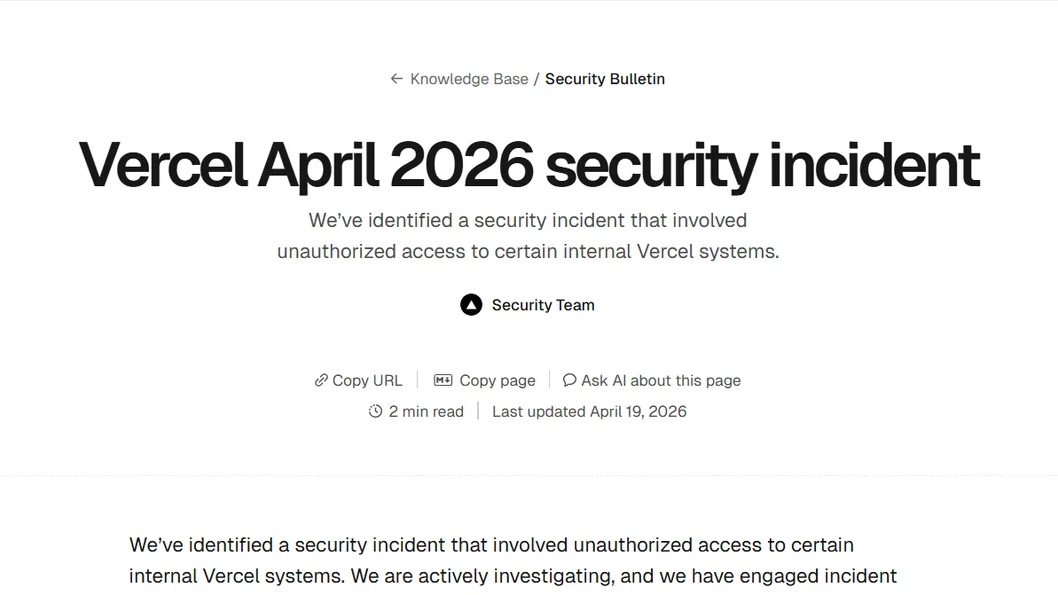
It has been a rough few weeks to be a developer. If you host your portfolio, your side project, or your startup on Vercel, you have probably already seen the notification. On April 19, 2026, Vercel confirmed what the security community had already begun piecing together: an unauthorized actor had accessed certain internal Vercel systems. If you have not been contacted directly by Vercel, the company says you are likely not affected. But "likely" is doing a lot of work in that sentence, and given the scope of what is being claimed on hacking forums, the full picture is still emerging.
Here at TechInKenya, we have been covering the growing wave of major security incidents in 2026, from Anthropic accidentally leaking the source map for Claude Code and internal documents describing their most dangerous model yet to the Axios supply chain attack that planted North Korean malware in a library downloaded over 100 million times a week. The Vercel breach is the latest episode in what is quickly becoming the most turbulent year in developer security in recent memory. Let us break down what actually happened, what you should do right now, and, yes, whether someone just used Mythos early access to pull this off.
How It Actually Happened: A Roblox Script That Brought Down a Dev Platform
This is where the story gets both technically fascinating and deeply human. The entry point for the entire Vercel breach was not a sophisticated zero-day exploit. It was not an AI agent autonomously chaining vulnerabilities in the dark. It was a Context.ai employee downloading what were almost certainly Roblox "auto-farm" scripts.
Context.ai is a third-party AI tool that Vercel employees used internally. In February 2026, threat intelligence firm Hudson Rock identified that a Context.ai employee with significant access privileges was compromised by Lumma Stealer, a widely distributed infostealer malware that is notorious for spreading through game cheats, cracked software, and, in this case, Roblox executors. The infected machine handed attackers a comprehensive set of corporate credentials: Google Workspace logins, Supabase keys, Datadog access, and Authkit credentials, including the [email protected] account.
With those credentials in hand, the attacker did not need to crack any encryption or find any zero-days. They used a malicious Google Workspace OAuth application to hijack a Vercel employee's Google account, and from there, pivoted into Vercel's internal infrastructure. Vercel has since published the malicious OAuth Client ID as an indicator of compromise: 110671459871-30f1spbu0hptbs60cb4vsmv79i7bbvqj.apps.googleusercontent.com. Any organization using Google Workspace should check their API controls for that application.
CEO Guillermo Rauch described the attacker as "sophisticated," citing their "operational velocity and detailed understanding of Vercel's systems." That framing is accurate in the sense that the attacker moved quickly and understood the target well. But it is worth being precise: the initial access was not sophisticated at all. Lumma Stealer is commercially available malware. The sophistication was in knowing exactly what to do with the credentials once they were in hand.
What the Attacker Claims to Have
This is where the confirmed facts end and the contested claims begin, and the gap between the two is significant.
A threat actor posting under the "ShinyHunters" name on BreachForums published a listing on April 19 claiming to be selling Vercel's internal data for $2 million, negotiable from $500,000 in Bitcoin. The listing claims to include multiple employee accounts with access to internal deployments, API keys, npm tokens, GitHub tokens, source code, and database data. As proof, the actor shared a text file containing records for 580 Vercel employees, including names, email addresses, account status, and activity timestamps, as well as a screenshot of what appears to be Vercel's internal enterprise dashboard.
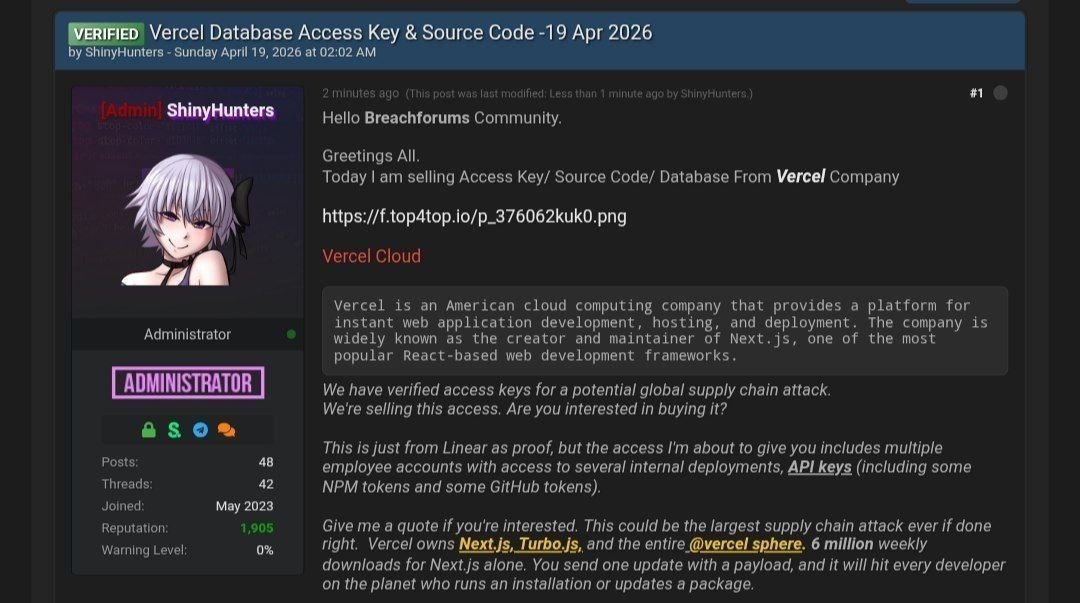
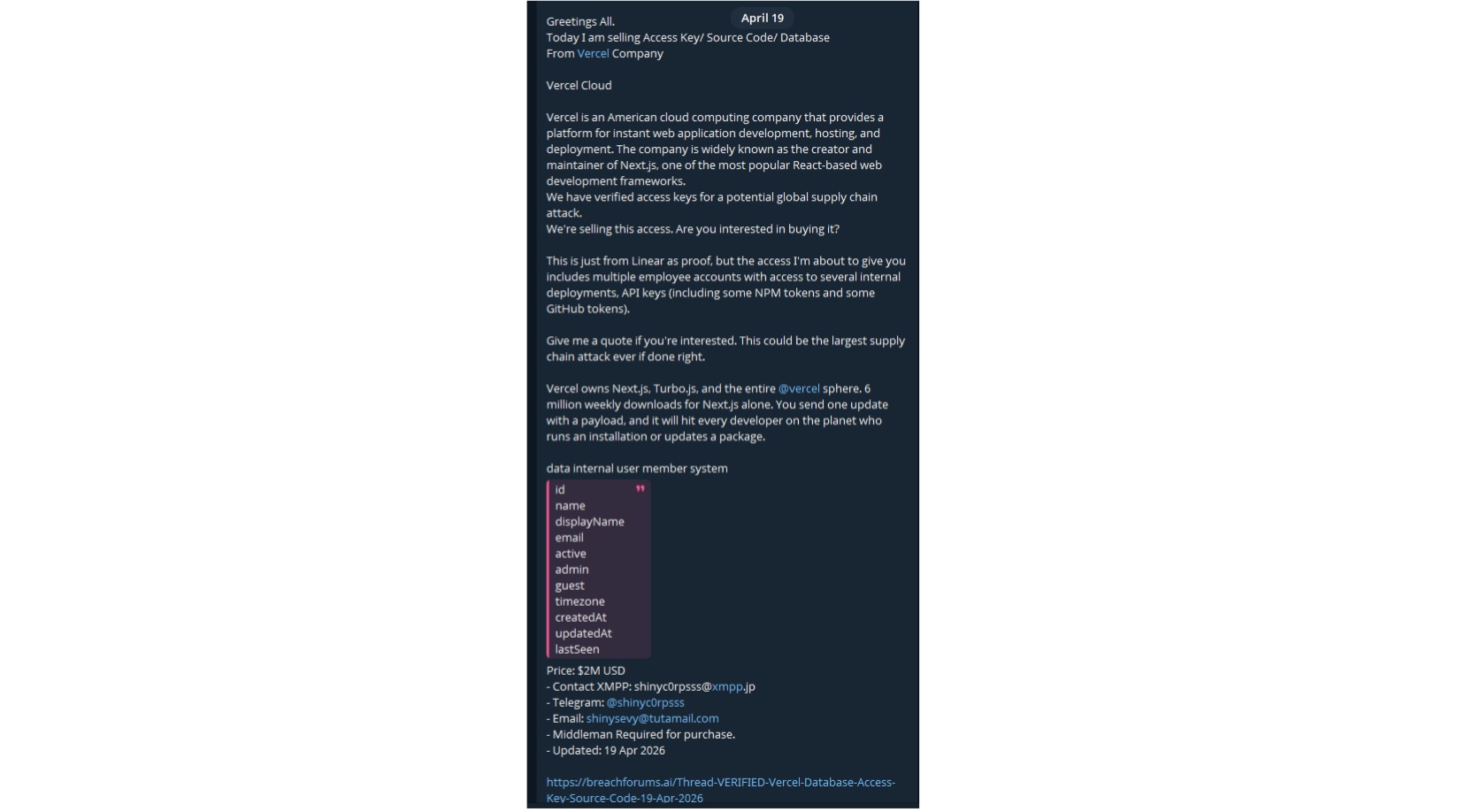
It is important to note that actual members of the ShinyHunters hacking group have separately denied to security media that they are involved in this incident. Whether that is true or a distancing tactic is unknown.
Vercel's own bulletin is notably terse. It confirms unauthorized access to "certain internal Vercel systems" and says a "limited subset of customers" was impacted and has been contacted. It does not confirm source code theft, and does not address the npm or GitHub token claims. CEO Rauch stated on X that the company has "analyzed our supply chain, ensuring Next.js, Turbopack, and our many open source projects remain safe." That statement is reassuring but does not cover the possibility that tokens granting write access to those repositories were briefly in the attacker's hands, even if they were not used.
The supply chain concern is the important one here. Vercel is the primary maintainer of Next.js, one of the most widely used web frameworks on earth, and Turbopack. If an attacker with valid GitHub or npm tokens published a malicious version of Next.js, the downstream impact would dwarf the Axios incident. As of publication, Vercel says no such tampering occurred. But until the investigation concludes and a more detailed post-mortem is published, this remains an open question that deserves to be taken seriously.
What Vercel Users Should Do Right Now
If you have a project on Vercel, here is your practical checklist, ordered by urgency.
First, check your email. Vercel says it has contacted affected customers directly. If you have not received a message, you are likely in the clear, but do not assume that means you can skip the rest of these steps.
Second, rotate all environment variables that are not marked as "sensitive." This is the most directly relevant action. The attacker accessed non-sensitive environment variables in Vercel's internal systems. Sensitive variables, those marked with Vercel's encrypted storage feature, appear to have been protected. Any API keys, database connection strings, third-party service tokens, or other secrets stored as plain environment variables should be considered potentially exposed and rotated immediately. Vercel has rolled out a new dashboard view specifically to help you audit these.
Third, check your dashboard and CLI logs for unusual activity. Look for deployments you did not initiate, changes to environment variables you did not make, or any team member access from unexpected locations or times.
Fourth, if your project is connected to GitHub, review your GitHub repository's authorized OAuth applications and recently active tokens. Go to Settings, then Developer Settings, then Personal Access Tokens, and check for anything unfamiliar. Do the same for your repository's deployment keys.
Fifth, if you use npm to publish packages connected to your Vercel projects, review your npm account's published versions and recent activity. The Axios incident from three weeks ago should have you doing this anyway.
Finally, check your Google Workspace connected applications if your organization uses Google for SSO with Vercel. Vercel published the malicious OAuth Client ID that was used in this attack. Search for it in your Google Admin Console under API Controls.
A Note on the Mythos Theory
We promised you a joke, so here it is: someone on Twitter has already suggested that the Vercel attacker must have gotten early access to Claude Mythos, used it to autonomously chain the Context.ai OAuth credentials into a Vercel infrastructure compromise, and is now demanding $2 million just like a proper enterprise security firm would.
Honestly? The attribution for this one is far more mundane, and that is precisely what makes it terrifying. The most powerful hacking tool deployed in this incident was a Roblox cheat script. The attacker did not need Mythos. They did not need a 72.4 percent exploit success rate or a 20-gadget ROP chain. They needed one Context.ai employee to make one bad download on a company machine, and then they needed to know where to pivot from there.
That is the uncomfortable truth about 2026 security. We are spending enormous energy worrying about what AI can do to our defenses, while the oldest tricks in the social engineering playbook are still opening doors just fine.
2026 Has Been a Catastrophic Year for Developer Trust
The Vercel breach does not exist in isolation. It is the latest in a string of incidents that have systematically undermined the trust developers place in the tools they use every day, and it is worth naming them together.
In late March, the Axios npm supply chain attack, attributed by both Google and Microsoft to the North Korean state actor UNC1069, planted a remote access trojan in versions of one of JavaScript's most-used HTTP libraries. The two malicious versions, [email protected] and [email protected], were live for just over three hours before detection, but Axios is present in roughly 80 percent of cloud and code environments and had over 100 million weekly downloads. Even that brief window was enough to cause real downstream compromise.
The attack entry point was a targeted social engineering operation against Axios's lead maintainer, Jason Saayman, who later published a post-mortem describing how the attackers built a convincingly fake company identity, a cloned Slack workspace, and what appeared to be a legitimate Microsoft Teams call to extract his npm credentials. One social engineering call. One compromised maintainer account. One hundred million weekly downloads suddenly weaponized.
Earlier the same month, Anthropic's Claude Code npm package shipped with a 59.8 MB source map that should never have been there, exposing 512,000 lines of unobfuscated TypeScript source code to the public. That incident also exposed internal model codenames, architectural details, and references to Mythos that confirmed capabilities Anthropic was not yet ready to announce publicly. Someone forgot to add a single line to a .npmignore file, and within hours the codebase had been forked over 41,500 times and mirrored permanently.
In February, Truffle Security published a report showing that nearly 3,000 Google Cloud API keys, the kind developers have been embedding in public JavaScript for years because Google itself said they were safe, had silently gained access to Gemini AI endpoints when the Generative Language API was enabled on their projects. Google initially classified this as "intended behavior." One developer found themselves facing an $82,314 bill generated in 24 hours by attackers who scraped their API key from a public webpage. Google has since implemented detection measures, but the root-cause fix, preventing existing keys from automatically inheriting new API scopes without notice, remained in progress as of the disclosure window.
Each of these incidents follows the same underlying pattern: a tool that developers trusted, built their workflows around, and embedded deeply into their infrastructure quietly became a liability, and the notification came too late or not at all.
The Real Lesson of 2026
There is a version of the 2026 security story that focuses on AI. Mythos is finding vulnerabilities faster than humans can patch them. AI agents are being used to accelerate attacks. The CrowdStrike 2026 Global Threat Report documents an 89 percent year-over-year surge in AI-augmented attacks, with the average criminal breakout time now down to 29 minutes.
All of that is real. But the Vercel breach, the Axios attack, the Google API key issue, and the Anthropic source map leak share a more fundamental lesson: the most dangerous vulnerabilities in 2026 are not the ones Mythos is finding in FreeBSD kernel code. They are the ones hiding in the assumption that the tools you trust are configured the way you think they are.
A Roblox script on one employee's machine can cascade into a potential supply chain risk for millions of developers. A missing line in an .npmignore file can expose half a million lines of proprietary source code. An API key you embedded in good faith three years ago, following the platform's own guidance, can now drain your budget or expose your users' data without a single line of code changing.
The era of passive trust in developer infrastructure is over. In its place, the industry needs a posture that assumes credentials will leak, that third-party tools will be compromised, and that the attack surface is not just your own code but everything your code depends on. Rotate your secrets regularly. Audit your connected applications. Lock down your environment variables. Mark sensitive variables as sensitive, because the difference matters when someone else is inside your host's systems.
Vercel's services are operational. Next.js is safe. Your project is probably fine. But "probably" is only good enough until it is not, and 2026 has made very clear that the window between "probably fine" and "rotating everything at 2 AM" is shorter than most developers want to believe.
Comments