 By
By 
Three days. That is how long Claude Fable 5 and Claude Mythos 5 lasted in the wild before the US government ordered Anthropic to pull the plug on both models worldwide. On June 9, 2026, Anthropic launched what it called its most capable public model ever. By the evening of June 12, an export control directive citing "national security authorities" forced Anthropic to disable access for every customer on the planet, including its own foreign national employees.
If you read our earlier piece, "The Myth of Mythos: Why Anthropic Is Selling You Fear Before They Sell You Safety," you'll remember our core argument: Anthropic has built a business model where the scariness of its own models is part of the pitch. Every launch comes wrapped in warnings about catastrophic misuse, cyberweapons, and existential risk, conveniently timed right before a funding round.
This week's events complicate that story, but they don't erase it. If anything, they reveal something messier and arguably more important: a regulatory system that is now reacting to AI hype almost as fast as labs can generate it, sometimes without waiting to confirm whether the hype is true.
What Actually Happened
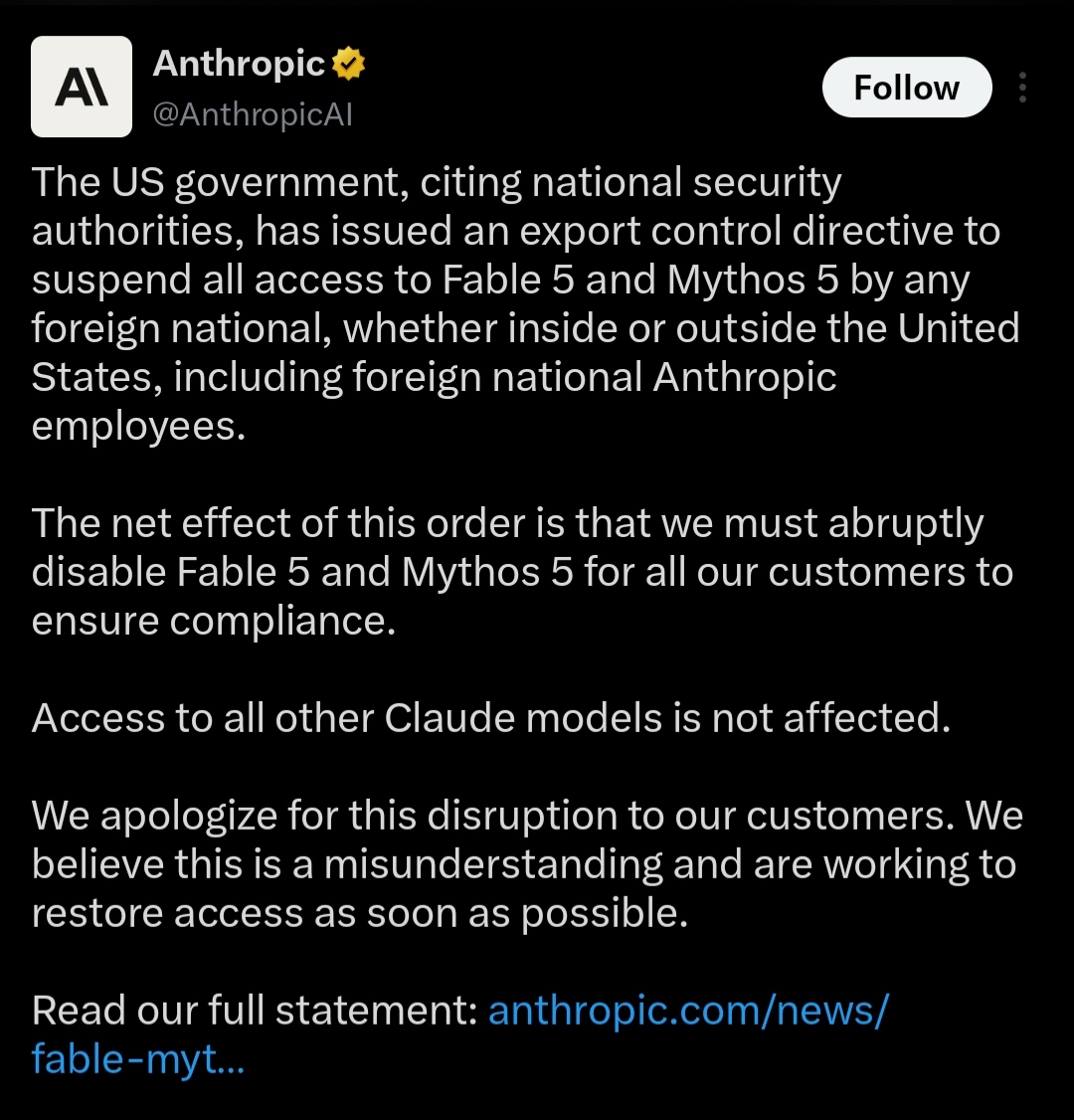
According to Anthropic's own statement, the directive arrived at 5:21pm Eastern on June 12. The letter did not specify the exact national security concern, but Anthropic's understanding is that the government became aware of a method for "jailbreaking" Fable 5, essentially a way to bypass its safety guardrails.
Anthropic says it reviewed the demonstration behind this and found it amounted to a narrow, non-universal jailbreak: a way to get the model to read a codebase and identify a handful of previously known, relatively simple vulnerabilities. Crucially, Anthropic claims other publicly available models, including OpenAI's GPT-5.5, can find these same vulnerabilities without needing any jailbreak at all.
In Anthropic's words, no universal jailbreak (one that broadly unlocks dangerous cyber capabilities across the board) has been found. What was reportedly demonstrated to the government was, by Anthropic's account, something closer to "the model can help find bugs in code," which is also something defenders use every day.
Because the export control directive applies to any foreign national anywhere, including Anthropic's own staff, the company says the only practical way to comply was to shut both models down entirely, for everyone, rather than try to selectively restrict access by nationality. Every other Claude model remains unaffected.
Anthropic's response is notably blunt for a company that usually leans into safety messaging. It says it disagrees with the action, calls it a misunderstanding, and argues that if "a narrow potential jailbreak" is sufficient grounds to recall a commercially deployed model, "it would essentially halt all new model deployments for all frontier model providers."
Why This Doesn't Prove Anthropic Built "The Best Weapon"
It's tempting, especially after our last article, to read this as confirmation that Anthropic's models really are as dangerous as the marketing suggests, perhaps even more so, since now a government has acted on it. But that reading doesn't hold up well against the actual sequence of events.
A government export control directive is not a verdict on capability. It's a regulatory action triggered by a report of a vulnerability, one that Anthropic disputes the severity of, and one that by Anthropic's account is already replicable by competing models without any special bypass. If the underlying capability genuinely isn't unique to Fable or Mythos, then banning only Anthropic's models doesn't tell us much about how powerful those models actually are relative to everything else on the market.
What it does tell us is that the US government is willing to act fast, abruptly, and broadly when it believes a frontier AI system might pose a security risk, even when the evidence presented is, in Anthropic's framing, "verbal" and lacking specific detail.
That's a very different headline than "government bans Anthropic's model because it's too powerful to exist." It's closer to "government bans Anthropic's model because it's worried, possibly more than the facts currently justify, and would rather act first and sort out the details later."
The Real Story: Regulation Can't Keep Pace With Release Cycles
Here's where we'll soften our earlier critique a little. Our original piece argued that Anthropic's repeated invocations of catastrophic risk were largely a marketing device, a way of making "this model could end the world" sound like a feature rather than a bug. We still think there's truth to that. But this week's events suggest something else is also true: regulators increasingly can't tell the difference between marketing-driven fear and genuine cause for concern, because they don't have the time, tools, or technical depth to evaluate frontier models on the timescale labs are now shipping them.
Anthropic itself has acknowledged this dynamic publicly, in its "Policy on the AI Exponential" framework, which argues that policymakers need a transparent, fair process to evaluate and potentially block dangerous deployments. The irony is that this week's action looks like exactly the kind of move Anthropic warned could happen if that process isn't built properly: a fast, opaque, broad-brush intervention based on incomplete information.
Consider the pace involved. Fable 5 and Mythos 5 launched on June 9. A jailbreak demonstration was reportedly shared with the government sometime in the following 72 hours. By June 12, an export control directive, the kind of instrument typically associated with restricting weapons technology or sensitive semiconductors, was issued for a chatbot model. According to reporting from Isaacus, this appears to be the first time the US has issued an export control directive for LLM access at all.
When the regulatory toolkit's response to "we're worried about this AI model" is "ban it for every foreign national on Earth, including the company's own staff, with three days' notice and no detailed evidence," that's not a sign of careful oversight. It's a sign of an agency that knows it's behind and is choosing to err drastically on the side of caution because it has no better option. Better safe than sorry, as I put it, but "safe" here means "blunt enough to shut down a global product overnight based on a report nobody outside the agency has fully seen."
What This Means for Anthropic's Valuation Story
Now, to the investor angle, because that's where this gets genuinely interesting for our audience.
Anthropic was reportedly valued around 980 billion dollars in its most recent funding round. The instinct might be to assume a government ban on your newest flagship product is bad news for that number. And in the short term, it probably doesn't help; headlines about regulatory bans rarely calm investor nerves.
But there's a more cynical read, and it's one that fits uncomfortably well with our original "Myth of Mythos" thesis. Anthropic's entire pitch to investors has been that its models are at the frontier of capability and risk simultaneously, and that this dual nature is precisely why Anthropic, not its competitors, should be trusted with the resources to build AGI safely. A government ban, regardless of the underlying technical merits, is a vivid, real-world demonstration that someone with real authority believes Anthropic's models are powerful enough to warrant export controls.
For a company whose valuation is built substantially on a narrative of "we are building something so significant that the rules of normal software companies don't apply to us," having a government agency treat your product like a controlled technology, even briefly, even disputedly, is a strange kind of validation. It doesn't matter whether the jailbreak was "real" in the sense of being uniquely dangerous. What matters for the narrative is that it happened, it was newsworthy, and it reinforces the idea that Anthropic operates in a different risk category than other AI labs.
Whether this pushes Anthropic past a trillion dollar valuation, as has been speculated, is genuinely hard to predict. Markets could read this as "regulatory risk just got real for AI labs," which is a negative for valuations across the sector, not just Anthropic. Or they could read it as "Anthropic's models are taken seriously enough by the US government to warrant export controls," which, however perversely, fits the existing hype narrative investors have already bought into. Both readings are plausible. Neither is certain.
Connecting the Dots: Hype, Fear, and the Trillion Dollar Question
This brings us back to our other recent piece, "Everyone's Betting Trillions on AI, So Why Has Nobody Found the Business Case?" That article asked a simple question: if AI valuations are running this far ahead of demonstrated revenue and use cases, what exactly are investors pricing in?
Events like this week's ban offer one answer: investors may be pricing in narrative momentum as much as fundamentals. A trillion dollar valuation isn't purely a bet on subscription revenue or API usage. It's increasingly a bet on which lab is positioned as the one governments, enterprises, and the public believe is "ahead," for better or worse. An export control directive, even one Anthropic disputes and calls a misunderstanding, becomes part of that positioning whether Anthropic wanted it or not.
That's not necessarily healthy for the industry. When the regulatory system's primary tool is "ban it now, ask questions later," and when the businesses being regulated have an incentive to lean into "we're so powerful we're scary" framing anyway, you end up with a feedback loop where regulatory overreaction and corporate hype reinforce each other, regardless of what the underlying technology can actually do.
What Better Oversight Would Look Like
If there's a constructive takeaway here, it's this: both AI labs and regulators would benefit from a process that doesn't rely on either marketing claims or worst-case-scenario directives issued with three days' notice and minimal evidence.
Anthropic has called for exactly this kind of framework publicly, evaluation processes with technical depth, transparency about what triggered an action, and proportionality between the evidence and the response. This week's events are, in a sense, a real-world stress test of the absence of that framework. A vulnerability report that Anthropic disputes as minor and non-unique somehow translated into a global shutdown of two flagship products within 72 hours of launch, with no detailed public explanation of what was actually found.
Whether or not you think Anthropic's models deserve that level of scrutiny, and there's a reasonable argument that frontier models do deserve serious scrutiny, the process by which that scrutiny gets applied matters. Right now, it looks less like oversight and more like a fire alarm being pulled because nobody's sure where the smoke is coming from, and pulling the alarm is easier than finding out.
For our readers, particularly anyone building on top of US-based AI models, the practical lesson might be the one raised by Isaacus in their response to the ban: any application depending on a US-based LLM is now demonstrably subject to being shut down at any moment, by export control directive, with essentially no warning. That's a sovereignty and reliability risk that goes well beyond questions of whether any individual model is "too dangerous." It's a question of how much control you actually have over the AI infrastructure your business depends on, and this week, the answer for two of Anthropic's models turned out to be: none at all.
Comments