 By
By 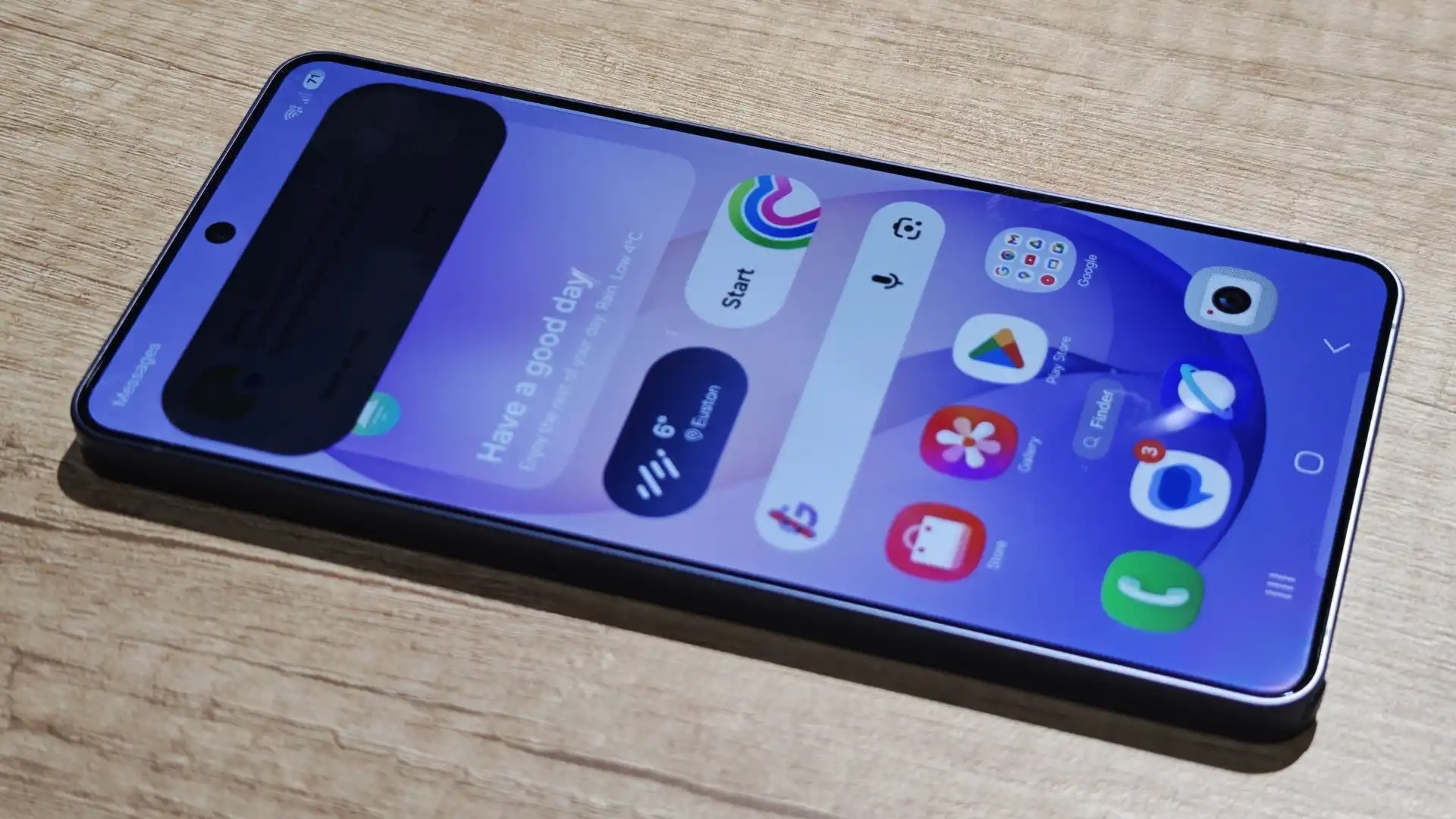
You know the feeling. You are on a matatu, M-Pesa app open, about to send money or check your balance. You glance up. The person next to you is not even trying to be subtle. You angle the phone away, cup your hand around the screen, do the awkward shuffle that every Kenyan who has ever done mobile banking in public knows well.
Samsung's Galaxy S26 Ultra, announced yesterday at Galaxy Unpacked, has a hardware answer to that problem. They are calling it Privacy Display, and it is the first time a smartphone manufacturer has built a working privacy screen directly into the panel itself, not as a stick-on protector, not as a software trick, but as a genuine hardware feature that operates at the pixel level. Five years in development. And reviewers who went hands-on in San Francisco are calling it one of the best genuinely new smartphone features in years.
The phone itself starts at Ksh 167,000 and most of you will not be buying it. That is fine. The story here is the technology because what ships in the S26 Ultra today tends to reach mid-range Samsung phones within two years. If this feature works as advertised, it will eventually be in a Ksh 40,000 Galaxy A-series phone. And that is when it becomes relevant for virtually every Kenyan who has ever done mobile banking on a crowded bus.
How Privacy Display Actually Works
The technology behind Privacy Display is called Flex Magic Pixel, a new OLED panel developed by Samsung Display that has been in development since 2021.
To understand what makes it novel, you need to understand a basic property of OLED screens. OLED displays have exceptional viewing angles, light from each pixel disperses broadly, which is why you can hand your phone to someone across the table and the screen looks perfect from almost any direction. That wide-angle light dispersion is usually considered a strength. For privacy, it is a problem.
Flex Magic Pixel addresses this by building two types of pixels into the same panel: Narrow pixels and Wide pixels. These two pixel types differ in how they disperse light.
In normal mode, both types are fully active. Light spreads in all directions, viewing angles are wide, the screen looks brilliant from anywhere. This is standard OLED behaviour.
When Privacy Display is switched on, the Narrow pixels remain active while the Wide pixels drop to a minimal level. This significantly limits side-angle visibility, the screen stays clear and readable for the person holding the phone head-on, but becomes difficult or impossible to see from an angle.
A more technical explanation describes a two-layer optical system: microscopic louvers activated by liquid crystals first redirect wide-angle light, then prism-like refraction layers block or internally reflect it. Side-angle viewers see little to nothing, while the screen stays clear and sharp when viewed head-on.
The key point and the one that separates this from physical privacy screen protectors, is that it is not simply a polarizer layer on top of the screen. Samsung built Privacy Display directly into the panel at the pixel level, so when the feature is disabled, the AMOLED screen is as bright and crisp as ever.
The Settings That Matter
Privacy Display on the S26 Ultra is not binary. Samsung built three layers of control into it.
Standard mode narrows the viewing angle noticeably. Someone standing beside you or reading over your shoulder will struggle to make out what is on your screen. The effect is clear in hands-on demos, though reviewers note that at shallower angles ( not directly to the side but at maybe 30 or 40 degrees) content is still visible with some effort.
Maximum Privacy Protection takes it further. This dims the screen further and narrows the field of view even more, making it even harder to see from a side angle. Samsung does note that this maximum setting can also affect normal viewing angles slightly, so it may not be something you keep on permanently.
Partial Screen Privacy is the feature that impressed reviewers most. Privacy Display can apply to small portions of the display rather than the entire screen, specifically, it can hide notification pop-ups while leaving the rest of the display unaffected. The masking around the notification works nearly perfectly. So when an M-Pesa transaction confirmation pops up or a banking OTP arrives as a notification, only that notification gets obscured. The rest of your screen ( whatever you are reading or watching) stays fully visible.
Beyond manual toggling, the feature fires up automatically when you are entering sensitive information such as passwords, OTPs, or PINs, and does not degrade viewing angles when disabled. You can also set it to activate per-app, so your banking apps always trigger Privacy Display, while YouTube and WhatsApp do not.
The feature works in both portrait and landscape orientations, which matters because many people consume content horizontally and you do not want a privacy mode that breaks the moment you rotate your phone.
The M-Pesa Problem This Solves
It is worth being specific about the threat model here, because "shoulder surfing" can sound abstract until you think through what it actually enables.
The most common scenario in Kenya is transactional. Someone watches you enter your M-Pesa PIN in a supermarket queue, on public transport, or at a mobile money agent. They note the number. Combined with your phone number ( visible on your screen, or obtained through social engineering) they have the two pieces of information needed to attempt account access or SIM swap preparation.
The more sophisticated scenario involves OTPs. When your bank or M-Pesa sends a one-time password as an SMS, that message often previews in a notification on your lock screen or at the top of the display. If someone near you catches that six-digit code in the seconds it is visible, and they already have your phone number and enough personal detail to call your telco, you have a problem.
Privacy Display's partial screen mode (obscuring only the notification while leaving the rest of the screen visible) is specifically designed for this second scenario. The OTP appears, you see it, the person next to you does not.
None of this eliminates fraud. A determined attacker with a telephoto lens, social engineering skills, and patience can work around any hardware privacy feature. But the casual opportunist who profits from inattentive moments in public spaces, the scenario that accounts for the vast majority of phone-related financial fraud, is directly addressed by this technology.
What You Are Actually Getting for Ksh 167,000
Since I am writing about a phone most readers will not buy, it is worth a quick accounting of what else the S26 Ultra brings and whether the overall package is coherent.
The rest of the specs are genuinely strong but iterative. The 200MP primary camera gets a wider f/1.4 aperture (up from f/1.7 on the S25 Ultra ) which Samsung claims allows 47% more light capture. Real-world difference in daylight is minimal; in low light it should be more meaningful. The 50MP 5x telephoto and 50MP ultrawide round out a camera system that was already excellent. Reviewers have flagged that the sensor sizes themselves have not changed, so aperture improvement is the main camera story.
The Snapdragon 8 Elite Gen 5 is a notable detail, the S26 Ultra gets a customised version of the chip that standard S26 and S26 Plus models do not. In markets where Samsung ships Exynos variants, the Ultra gets Snapdragon regardless. That matters for sustained performance under load and for AI processing speed since many of Samsung's Galaxy AI features now run on-device rather than in the cloud.
The phone is 7.9mm thin, the slimmest Ultra yet, four grams lighter than its predecessor, and runs One UI 8.5 on Android 16. Super Fast Charging 3.0 gets the 5,000mAh battery to 75% in 30 minutes with a 60W adapter.
None of this is bad. All of it is predictable. If you own an S24 Ultra or S25 Ultra, there is no compelling reason to upgrade for anything except Privacy Display. If you are moving from an older Samsung flagship or a competitor, the full package is genuinely excellent at its price point, though that price point, at Ksh 167,000, narrows the audience considerably.
The Trickle-Down Timeline
Samsung's hardware innovations follow a predictable path. Features that debut in the Ultra tier reach the base Galaxy S series within one product cycle, roughly 12 months. They reach the Galaxy A-series within 18 to 24 months.
Flex Magic Pixel is a display panel technology developed by Samsung Display, Samsung's component subsidiary that supplies panels to the entire Samsung device lineup and to other manufacturers. Once the technology is at volume production, the cost curve drops. The marginal cost of including Flex Magic Pixel in a mid-range display falls significantly when Samsung Display is already manufacturing the panels at scale for flagships.
If Privacy Display works as demonstrated and adoption is strong among S26 Ultra buyers, there is a reasonable case that it appears in the Galaxy A56 or A76 (phones that sell in the Ksh 35,000 to Ksh 60,000 range) by 2027 or 2028. That is when this technology stops being a premium curiosity and becomes a genuine mass-market privacy tool for the Kenyan market.
That timeline is worth holding in mind. The S26 Ultra itself is not a phone for most Kenyan buyers. The technology inside it might be, sooner than people expect.
Should You Buy It?
If you are genuinely in the market for a flagship Android phone at the top of the price range, the S26 Ultra is excellent. Privacy Display is a real differentiator, the first of its kind and demonstrably effective in hands-on testing. The camera system is among the best available. The Snapdragon 8 Elite Gen 5 configuration is fast and well-cooled.
But the Samsung Galaxy S26 and S26 Plus (released alongside the Ultra) are less compelling stories. The base S26 starts at $899 and the S26 Plus at $1,099, both up from last year's pricing, with minimal changes from their predecessors. Neither gets Privacy Display. Neither gets the custom Snapdragon variant. If you are buying in that tier, you are paying more for less differentiation than the previous generation offered.
For Kenyan buyers watching this space: the S26 Ultra is available for pre-order now and ships globally from March 11. Expect local availability through Safaricom, Samsung Experience Stores, and authorised dealers in the Ksh 165,000 to Ksh 175,000 range depending on the retailer. The 256GB base configuration is the one to consider, the storage upgrade to 512GB rarely justifies the price jump for most users.
For everyone else: Privacy Display is the feature to watch. When it reaches a phone you can actually afford, it will be worth upgrading for.
Comments