 By
Kenya Electricity Generating Company PLC (KenGen) has appointed Ronoh Kibet Charles, its General Manager for Commercial Services, as its next Managing Director and Chief Executive Officer. Kibet takes over on February 1, 2027, from Eng. Peter Waweru Njenga, who is retiring. The announcement was made on October 24, 2026.
The appointment places an executive who has worked on KenGen's overseas geothermal consultancy and on the Olkaria Green Energy Park at the top of East Africa's largest power producer. It comes as the company tries to earn more from steam-field expertise and from industrial and computing customers, while a flagship geothermal-powered data centre plan in Olkaria remains stalled.
What KenGen announced
KenGen said the appointment followed a competitive recruitment process and that a transition period will allow for a handover. Njenga remains in office until his retirement.
The search began in August 2026, when KenGen advertised the vacancy. It was reported at the time that Njenga was due to leave on reaching the mandatory retirement age of 60. He was appointed on August 18, 2023, for a three-year term, taking over from Abraham Serem, who had been acting in the role. Njenga joined Kenya Power as a graduate trainee in 1991 and was the utility's General Manager for Infrastructure Development before moving to KenGen, according to the board's 2023 statement.
Who Kibet is
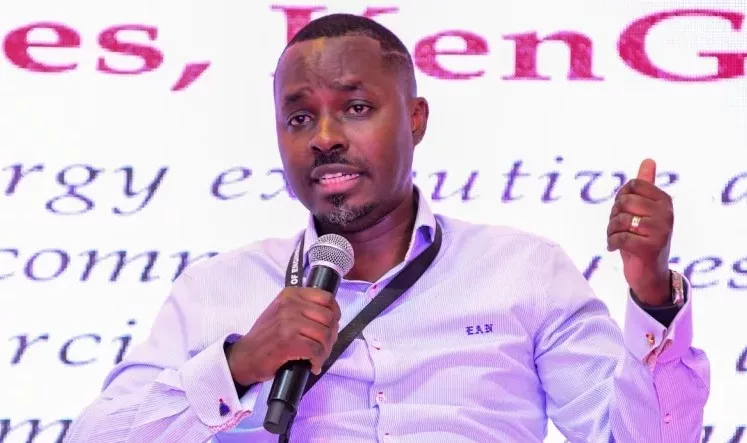
Kibet has more than 17 years of experience in geothermal development, project delivery and commercial strategy, according to KenGen's announcement as. He has been involved in expanding the company's international consultancy services and in developing the Olkaria Green Energy Park.
KenGen's executive profile describes him as an electrical engineer trained at the Jomo Kenyatta University of Agriculture and Technology (JKUAT), with a specialisation in telecommunication and information engineering. He holds a master's degree in project management, is pursuing a PhD in the same field, and is a certified Project Management Professional and SAP project systems consultant. He has also completed an organisational leadership programme at Harvard Business School.
In his current role, Kibet oversees the investment, new business and partnerships divisions, as well as marketing, corporate communication and sustainability. Before joining KenGen he worked as a project manager at JNET Intelligent Technologies, handling telecommunications and ICT solutions. That background is relevant to a company that now counts data centres among its prospective customers.
The Njenga years: profit gains, then a flat year
KenGen credited Njenga with strengthening financial performance, advancing diversification and expanding its geothermal consultancy portfolio, including assignments in Eswatini.
The company's audited results for the year ended June 30, 2025, are the basis for the profit figure cited in the announcement. Profit after tax rose 54 percent to KSh 10.48 billion from KSh 6.8 billion a year earlier, while revenue was broadly flat at KSh 56.1 billion. Operating expenses fell 11 percent to KSh 35.14 billion, which explains most of the gain. Revenue from non-traditional ventures grew 235 percent in that year, driven in part by completed geothermal drilling work in Eswatini, according to KenGen.
The most recent results show a flatter picture. For the year ended June 30, 2026, KenGen reported profit after tax of KSh 10.35 billion, a 1.2 percent decline. Revenue rose 6.4 percent to KSh 59.7 billion. The company attributed the dip to lower finance income, which fell from KSh 4.1 billion to KSh 2.9 billion as cash was redeployed into capital investment. Borrowings fell by KSh 12.2 billion to KSh 97.1 billion. The board proposed a dividend of KSh 0.75 per share, down from KSh 0.90, for approval at the annual general meeting on October 29. Business Daily described it as KenGen's first profit decline in five years.
Demand is moving in the company's favour. National peak demand reached a record 2,549 MW on July 15, 2026, and KenGen supplied 8,975 GWh to the grid, or 57.2 percent of the total, according to its results. KenGen's installed capacity stands at 1,786 MW, of which geothermal accounts for 754 MW and hydro for 826 MW, based on figures in its company statements.
Consultancy as a second revenue line
Selling drilling and steam-field services abroad is the part of KenGen's diversification strategy with the clearest track record. The company completed geothermal work in Eswatini and has an upcoming geothermal drilling project at Ngozi in Tanzania, according to its FY2025 results. KenGen's 2025 annual report summary lists consultancy, e-mobility and carbon trading as the ventures meant to grow revenue outside electricity generation.
For the incoming CEO, consultancy has practical appeal. It uses drilling rigs, engineers and reservoir knowledge the company already owns, and it earns fees without adding generation assets to the balance sheet. Its limits are scale and timing: contracts are project-based, and revenue can swing from year to year.
The Green Energy Park and the compute question
The Olkaria Green Energy Park is the other leg of diversification, and it is where Kibet's technology-adjacent background will matter most. The park covers 342 hectares in Naivasha and is planned for industrial, commercial and recreational use, according to ThinkGeoEnergy. Construction is planned in four phases between 2025 and 2045. The Konza Technopolis Development Authority (KoTDA) is the pioneering investor.
Two data centre projects have been linked to the park:
Olkaria EcoCloud. DatacenterDynamics reported that the first phase, known as Project Eagle, will provide 24 MW of IT capacity across eight 3 MW data halls, and that the facility is expected to draw 70 MW in total, buying power from KenGen at seven US cents per kilowatt hour. The campus was described as a 60 MW hyperscale development when its groundbreaking was held.
Microsoft and G42. In May 2024, the two companies announced a $1 billion plan for a geothermal-powered campus at Olkaria, starting at 100 MW and expandable to 1 GW, according to DatacenterDynamics. The completion target was May 2026.
The second project has not advanced as planned. In May 2026, ThinkGeoEnergy reported that President William Ruto had announced a suspension, citing the scale of power the facility would need compared with Kenya's installed capacity of about 3 GW. Bloomberg, as summarised by Investment Monitor, reported that the companies had asked the government to commit to buying a fixed amount of cloud capacity each year, and that talks broke down when it could not. ICT Principal Secretary John Tanui said the project was still active, and discussions continue on structuring and power supply, according to Winbuzzer's account.
The power arithmetic
The figures cited in these reports show why Olkaria's steam does not translate directly into data centre capacity. Using KenGen's published numbers, a 100 MW first phase would equal about 13 percent of the company's 754 MW geothermal fleet and about 4 percent of the record national peak of 2,549 MW. A 1 GW build-out would equal roughly 39 percent of that peak.
Delivery also depends on transmission. A data centre at Olkaria needs high-capacity lines and firm supply every hour it runs, which is a different requirement from generating enough energy over a year. Geothermal is a baseload source that runs day and night, which suits compute loads, but KenGen's output is already committed to the national grid, where it supplied more than half of all electricity in the last financial year.
KenGen has also been adding supply. It began rehabilitating the Olkaria 1 plant to raise output to 63 MW from 45 MW, according to Business Daily, and has said it will focus on expanding generation capacity to meet rising demand.
The Kenya Engineer report framed the task ahead of Kibet as converting KenGen's diversification initiatives into sustained growth while keeping generation reliable and strengthening its position in geothermal energy. When he takes office on February 1, the Microsoft and G42 campus will remain paused, according to the Data Center Index tracker, while the EcoCloud facility is the Olkaria data centre project that has broken ground.
Comments