 By
By 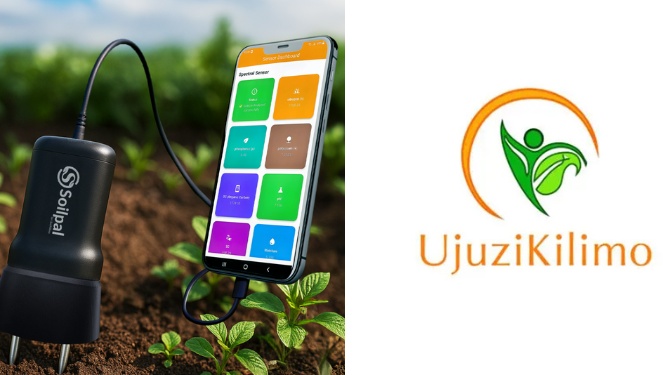
The "14-Day Wait" Problem: Agriculture’s Invisible Ceiling
For decades, the Kenyan farmer’s primary struggle wasn’t just the unpredictability of the long rains; it was a systemic "data lag." Traditionally, soil testing has been a logistical nightmare. A farmer in Eldoret or Makueni would have to dig samples, package them, pay between Ksh 1,500 and Ksh 8,000, and then wait up to 14 working days for a PDF to arrive from a laboratory in Nairobi or a regional center.
In the fast-moving window of a planting season, 14 days is an eternity. By the time the results arrived, the seeds were often already in the ground, and the fertilizer—often the wrong type for that specific soil—had already been applied. This "guesswork" farming is a leading cause of soil acidification and stagnant yields across the country.
Enter SoilPal Pro. Developed by Nairobi-based UjuziKilimo, this 105g device claims to do in 90 seconds what used to take two weeks. But is it just another gadget, or is it a genuine "M-PESA moment" for Kenyan agriculture?
1. The Tech: Spectroscopy vs. the "Wet Lab" Bureaucracy
To understand the disruption, one must understand the shift from chemistry to physics.
Traditional labs rely on "Wet" Chemistry. This involves complex processes: drying soil, grinding it, and dissolving it in various chemical reagents to observe reactions. It is the gold standard for accuracy, but it is manual, expensive, and virtually impossible to scale to millions of smallholders.
SoilPal Pro utilizes VNIR (Visible and Near-Infrared) Spectroscopy. Instead of dissolving the soil, the device "shines a light" on it.
The Process: The sensor emits specific wavelengths of light. Different soil nutrients (Nitrogen, Phosphorus, Potassium) and organic matter absorb and reflect this light in unique ways.
The Brains: The device captures this "spectral signature" and sends it via Bluetooth or USB-C to UjuziKilimo’s cloud-based AI. This AI isn't guessing; it compares the signature against a massive database of thousands of soil profiles from across East Africa.
The Result: Within two minutes, the farmer’s smartphone displays a breakdown of 13+ parameters. Beyond the standard NPK, it tracks Cation Exchange Capacity (CEC) and Total Organic Carbon, providing a much deeper health check than a basic lab test.
2. The Economics: Moving from OPEX to a Business-in-a-Box
The global sticker price of $399 (approx. Ksh 51,870) might seem like a non-starter for a farmer earning Ksh 50,000 a season. However, the localized business model is designed for a "service economy" rather than individual ownership.
Feature | Traditional Lab (Opex) | SoilPal Pro (Capex) |
|---|---|---|
Direct Cost | ksh 1500 - 8000 per sample | ksh 51,870 (One time purcahse) |
Turnaround | 10-14 working days | < 90 seconds |
Scalability | Fixed Capacity per lab | Unlimited (test 100 farms per day) |
Accessibility | Requires Travel to urban hubs | Fits in a pocket; goes to farm |
The real disruption lies in the "Vijana na SoilPal" initiative. By allowing youth to acquire the kit for a Ksh 10,000 deposit, UjuziKilimo has created a "Soil-Testing-as-a-Service" (STaaS) model. If an entrepreneur charges Ksh 1,000 per test (half the price of a lab), they can break even in just 50 tests—a feat achievable in a single sub-county within a week.
3. The SaaS Shift: Data Ownership or "Subscription Trap"?
Modern tech rarely stops at the hardware. SoilPal Pro is the gateway to the FarmSuite ecosystem. While basic testing is accessible, the "pro" features—yield estimations, historical tracking, and GPS farm mapping—require a monthly subscription of roughly $12.99 (Ksh 2,000).
For the traditionalist, this looks like a "subscription trap." However, the value lies in the Digital Twin. Every time a farmer tests their soil, they aren't just getting a one-off report; they are building a historical database of their land's health.
GPS Integration: The app tags every sample with coordinates, allowing for "heat maps" of a farm’s fertility.
Prescriptive Agronomy: Instead of telling a farmer they need "Nitrogen," the app lists specific local fertilizer brands (e.g., Mavuno, Yara, or Kelphos) and the exact number of bags required for their acreage.
4. Usability: Built for the "Last Mile"
One of the most thoughtful design choices is that the SoilPal Pro is bus-powered. It contains no internal lithium battery, which often fails in high-heat environments or becomes a brick if the charger is lost. It draws the tiny amount of power it needs directly from the user’s smartphone.
In a country where 4G coverage is expansive but electricity in the "interior" can be spotty, a device that relies solely on a charged phone is a significant win for field-readiness. Furthermore, the device is ruggedized to handle the dust and humidity typical of Kenyan farm cycles.
Final Verdict: The Democratization of Dirt
SoilPal Pro isn't just a faster way to measure pH; it is the decentralization of expertise. It takes the power out of the hands of the Nairobi-based lab technician and puts it into the pocket of a village-based agropreneur.
The comparison to M-PESA. M-PESA didn't replace banks; it made banking irrelevant for the "unbanked." Similarly, SoilPal Pro might not replace the high-precision chemistry required for research institutions, but for the 4.5 million smallholder farmers in Kenya, it makes the traditional soil lab an unnecessary detour.
The success of this tool will ultimately be measured in maize bags per acre. If precision data can truly deliver the promised 30% yield increase, then the Ksh 51,000 investment isn't a cost—it’s the most valuable seed a farmer can plant.
Comments