 By
By 
If you woke up to an email from Google yesterday with the subject line "Updates to your Google AI Pro plan," you were not alone. Subscribers across the world received the same message, and the reaction on social media has been, to put it mildly, not great. Google has overhauled how usage limits work on its AI Pro subscription, and what looked like a routine update is turning out to be a significant downgrade for many users.

Here is everything you need to know about what changed, why it matters, and what you can do about it.
What Google AI Pro Used to Look Like
To understand the weight of this change, you need to understand what the old system was. Before the Google I/O 2026 announcements, the AI Pro plan at $19.99 per month gave subscribers access to three main Gemini models with straightforward, fixed limits:
Flash was essentially unlimited for Pro subscribers. It was the workhorse model for everyday tasks, quick questions, and light coding work. You could use it all day without worrying about hitting any ceiling.
Gemini Pro came with a daily cap of 100 prompts. Earlier in the product's life, this limit sat at just 50 prompts per day before Google doubled it following user complaints. It was not infinite, but for most users, 100 prompts per day was enough headroom to work comfortably.
Thinking mode also came with 100 prompts per day, though it had its own dedicated resource pool after Google decoupled it from the Pro allocation in early 2026. Before that decoupling, Thinking and Pro shared a single usage bucket, which was an annoyance for power users who needed both.
The old system had a key quality that users valued above everything else: predictability. You knew exactly what you were getting. Whether you had 47 prompts remaining or 3, the number was right there, clear and honest.
What Changed on May 20, 2026
At Google I/O 2026, Google announced a sweeping restructuring of its AI subscription tiers. The spotlight was on the flashy new announcements. Google introduced three tiers: Google AI Plus for $7.99 (KES 900) per month with 200 GB of storage and double usage limits in Gemini, Google AI Pro for $19.99 (KES 3700) with 5 TB of storage, quadruple limits, and YouTube Premium Lite, and Google AI Ultra starting at $99.99 (KES 12500) with up to 20x limits and 20 TB of storage. Meanwhile, the previous top-tier plan was reduced from $250 to $200 per month.
The new model lineup also shifted. Flash-Lite, Flash, and Pro replace the old naming convention, with the $19.99/month AI Pro plan offering four times the limits of the free plan.
But buried beneath all that was the change nobody was celebrating: the complete replacement of fixed daily prompt limits with a compute-based usage system.
Under the updated system, usage limits now depend on the complexity of your prompt, the features you use, and the length of your chat. Instead of fixed prompt counts, usage is now calculated dynamically based on how resource-intensive a request is. Google said these limits refresh every five hours until users reach their broader weekly quota.
In plain language: Google can no longer tell you how many prompts you have left in a way that means anything, because every prompt costs a different and unpredictable amount.
Also gone is the 1,000 monthly AI credits that were previously bundled with the AI Pro subscription. Users will now need to purchase additional AI credits separately if they want to extend their limits on products such as Flow and Antigravity.
The Backlash Has Been Immediate and Harsh
The community response has been swift. A user on Reddit called the new limits "totally scam" because a single text prompt burned through 13% of their quota. Read that again: one prompt, 13% of the five-hour window, gone.
One frustrated user posted on Reddit that they canceled their Plus subscription after what they described as a massive, unannounced contract change, saying a simple five-post back-and-forth burned through 50% of their entire five-hour compute limit.
Subscribers report hitting invisible caps after as few as five prompts, leading to widespread frustration over automatic downgrades to the Flash model and a surge in subscription cancellations.
The situation gets worse when you look at what happens during those lockout periods. Paying customers on Gemini Pro and Ultra plans report that a handful of prompts or a few video generations are now entirely depleting their quotas, locking them out of the service for up to five hours.
There are also reports of the system misbehaving in ways that feel deeply unfair. Some users complained that failed media generations were still counting against usage limits, while others claimed they were automatically switched from the Pro model to the Flash version even after manually selecting Pro preferences.
This is the part that stings most: you pay $19.99, you pick the Pro model, and Gemini quietly swaps you to Flash without you noticing.
The Dramatic Effective Reduction in Limits
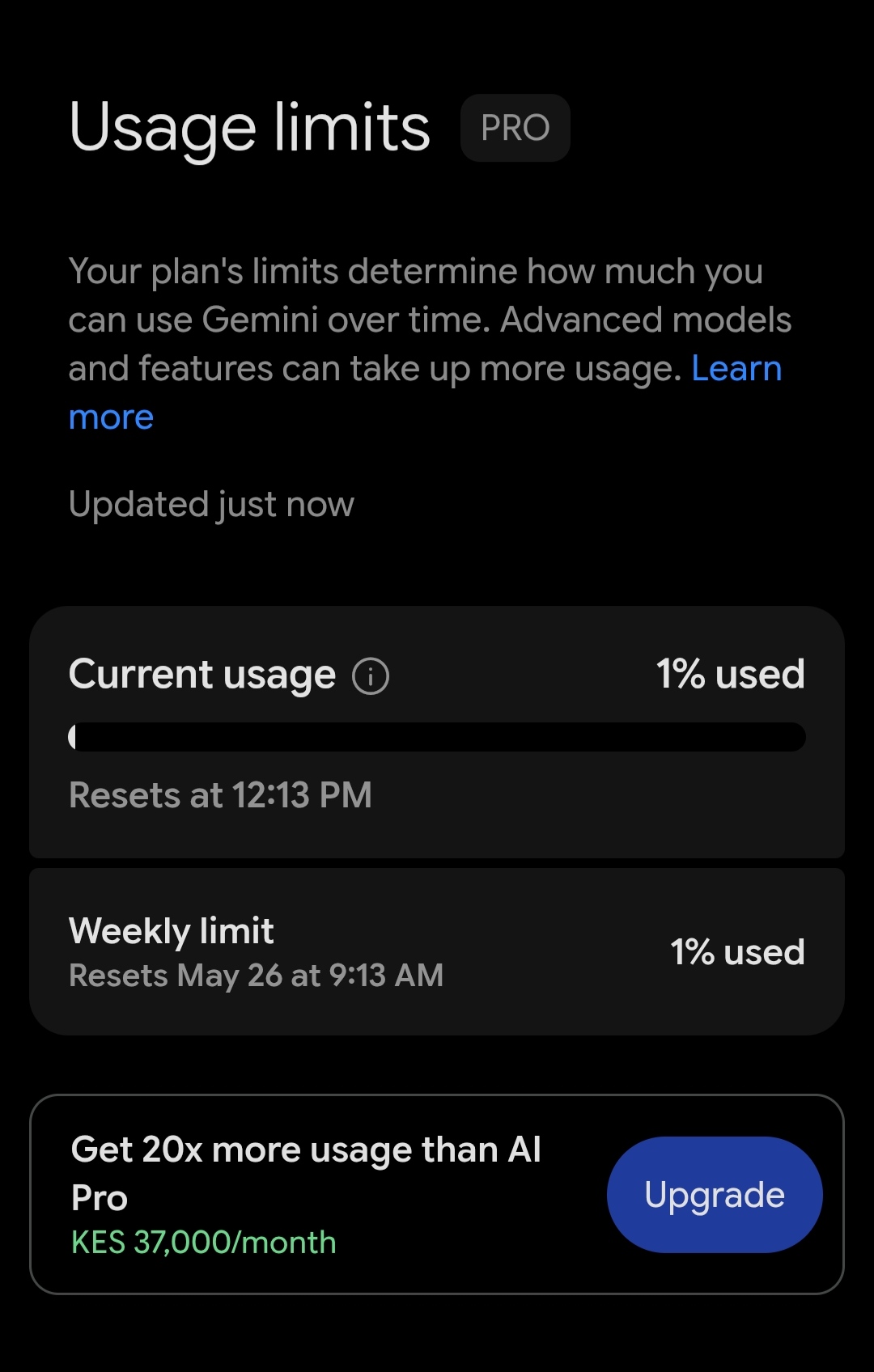
Here is where the numbers get truly uncomfortable. A Reddit user found that daily limits changed drastically after May 17, 2026. Previously, Google AI Plus users could enjoy 10 times the limit of the free Gemini service. Pro and Ultra users could use much more: 33 times and 166 times more than free users. Those limits are now 2x, 4x, and 20x respectively.
That is not a minor adjustment. Pro subscribers went from 33 times the free tier to just 4 times. Ultra subscribers went from 166 times the free tier to 20 times. These are enormous cuts, and Google announced them quietly in a routine-looking email rather than addressing them head-on at the I/O keynote.
It is hard not to notice the pattern here. Google chose to loudly announce the price cut on the AI Ultra plan from $250 to $200, but said very little about the fact that what you get per dollar on the AI Pro plan was being dramatically scaled back.
Why Is Google Doing This?
To be fair, there is a legitimate reason behind this industry-wide shift, even if the execution has been poor. As AI capabilities rapidly improve and become more compute-intensive, the flat-fee subscription model is under pressure. The argument being made across the industry is that having an unlimited plan is like having an unlimited electricity plan. It just does not make sense.
The new compute-based usage limits are another reflection of how powerful agentic AI features have broken flat-rate consumer AI plans. When Gemini can now run multi-step research tasks, generate video, write and run code, and operate as an autonomous agent in the background, the cost difference between a "simple" prompt and a "complex" one can be enormous.
Google's own justification is that the new system is more fair: a simple text question should cost less than a video generation request. That logic is sound. The problem is in the implementation. When users cannot see how much a task will cost before running it, and when a five-message chat can consume half a five-hour budget, the system feels less like fairness and more like a trap.
How This Compares to Anthropic's Approach
Google has adopted the same five-hour usage window model that Anthropic uses with Claude. But there are important differences in how it plays out in practice.
Anthropic's Claude Pro at $20 per month uses a rolling five-hour window too, but the community's historical experience with it has generally been that heavy users can get through substantial workloads before hitting limits. More importantly, Claude's interface gives users a visible indicator before they reach the ceiling, rather than just cutting them off mid-workflow.
The key frustration with Google's implementation is the opacity. Anthropic built its metering model into the product from a relatively early stage, so users adopted Claude knowing those rules. Google is changing the rules mid-subscription, on a product that built its reputation on generous limits, and doing so without clearly communicating the real impact.
You can track your Gemini usage at gemini.google.com/usage, but knowing you are almost at the limit after the fact is not the same as knowing the cost of an action before you take it.
What About the New Models?
It would be unfair to make this entirely a bad-news story. Google did deliver real value at I/O 2026 alongside these limit changes.
New features for all subscribers include Gemini Omni for creating and editing video from any input including text, images, and video, plus Gemini 3.5 Flash for fast testing and debugging. Ultra subscribers get access to Gemini Spark, an AI agent that runs tasks on its own across Google products, and Project Genie for building interactive worlds.
Other new features include AI Inbox in Gmail and Daily Brief in the Gemini app, with AI Inbox surfacing the most important tasks, suggesting replies, and linking relevant Docs, Sheets, and Slides, while Daily Brief pulls together morning updates from Gmail, Calendar, and Gemini chats.
These are genuinely compelling features. The problem is that some of them are gated behind the new $99.99 Ultra tier, and the features available on Pro are now more limited in how much you can actually use them before hitting a wall.
What Can You Do Right Now?
If you are an AI Pro subscriber and you are feeling the squeeze, here are some practical ways to stretch your compute budget:
Start fresh conversations. Long conversations accumulate context, and context costs compute. Every message in a long thread adds to the baseline cost of subsequent messages. Starting a new chat for a new topic, rather than continuing an existing one, can meaningfully reduce your compute burn.
Disable personal context. Gemini's personal intelligence features, where the model draws on your email, calendar, and history to personalize responses, consume additional compute. If you do not need that personalization, turning it off conserves your budget.
Use Flash-Lite for simple tasks. Not every task needs the Pro model. If you are drafting a quick email, summarizing a short article, or asking a factual question, Flash-Lite will cost significantly less compute while still doing a solid job.
Be concise in your prompts. Longer prompts cost more. This is the unfortunate reality of compute-based pricing. Front-load the most important information and cut anything unnecessary. It feels odd to optimize your communication style around a billing model, but here we are.
Reserve Pro for the work that actually needs it. Deep research, complex coding, long-form writing with back-and-forth feedback: these are the use cases that justify the higher compute cost. Casual browsing and simple questions do not.
The Bigger Picture: Is Flat-Rate AI Dead?
This moment with Google is not an isolated event. OpenAI is also exploring how to better align pricing with usage while still expanding access, with one executive noting that the company's north star is access. The industry is moving, slowly but clearly, toward metered usage as the norm.
For consumers, this creates a new kind of anxiety that did not exist before. Using AI used to feel like being at an all-you-can-eat buffet. You could experiment freely, run the same prompt in different ways to see which worked best, leave a conversation and come back to it, and generally treat the service as a tool without watching a meter. That era may be ending.
The real question for Google is whether the value equation still makes sense at $19.99 per month under these new rules. For a user who primarily uses Flash for quick tasks throughout the day, probably yes. For a power user who does deep research, multi-turn coding sessions, and media generation, the math has shifted considerably. That user is now being nudged toward the $99.99 Ultra tier, and the nudging was done without a straight conversation about what was being taken away.
Getting locked out for hours after hitting the limit is frustrating for many, and some have already begun to unsubscribe. This trend could continue if Google does nothing to address these complaints.
That outcome would be bad for everyone. Gemini has made genuinely impressive progress over the past year, and it would be a shame to see subscriber trust erode over a pricing model change that could have been handled with more transparency and more generous baseline limits.
Google has until the next billing cycle to prove that the new system, in practice, is not as bad as early users are reporting. The technical capability is clearly there. The question is whether the product team will listen to what its users are telling them.
Conclusion
What happened on May 20, 2026 is a significant inflection point for Gemini as a product. The switch from fixed, predictable prompt limits to an opaque compute-based system, the removal of the 1,000 monthly Flow credits, and the effective reduction in what Pro subscribers get for their $19.99 all represent a meaningful erosion of value.
The frustration is justified. Users built workflows around the old system. They chose Gemini Pro in part because the value proposition was clear. That clarity is now gone.
The compute-based model is not inherently wrong. The AI industry genuinely cannot sustain unlimited usage as capabilities grow. But there is a right way and a wrong way to make that transition, and sending a low-key email on the day the changes take effect, without transparent numbers or an honest conversation about the effective limit reduction, is not the right way.
Google has the talent, the infrastructure, and the models to build the best AI subscription on the market. Now it needs to show users that it respects them enough to be honest about what they are getting.
Comments