 By
By 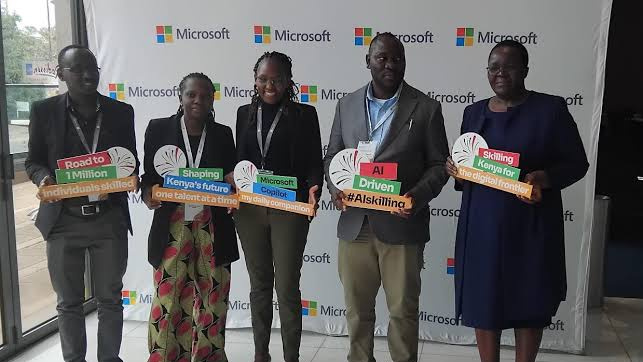
For as long as Kenya has worn the "Silicon Savannah" label, a familiar complaint has trailed it. The tech opportunity, the argument goes, lives almost entirely in Nairobi. Coders in Kilifi, entrepreneurs in Embu, and trainers in Taita Taveta have often had to watch the digital economy grow from a distance, mostly through their phone screens.
Microsoft and the Stanbic Kenya Foundation are betting they can change that pattern, at least for artificial intelligence skills. The two organisations, working alongside Konza Technopolis and Pathways Technologies, have expanded the Microsoft Elevate AI National Skilling Initiative into five counties outside the capital. It is a small but telling experiment in whether AI training in Kenya can be built around the country rather than just around its biggest city.
What the Program Actually Does
The initiative has so far trained 152 participants across Kwale, Kilifi, Mombasa, Taita Taveta, and Embu. These are coastal and eastern counties that rarely feature in conversations about Kenya's tech sector, despite hosting large populations of youth, small traders, and informal businesses that could genuinely use AI tools.
Rather than run generic coding bootcamps, the program leans on Stanbic Kenya Foundation's existing relationships with TVETs (Technical and Vocational Education and Training institutions) and community networks. Mercy Githanji, who heads the Stanbic Foundation, has described digital literacy as one of the foundation's core pillars, with the current push aimed at building the capacity of instructors who can then pass AI skills on to students and entrepreneurs long after the initial training ends. That train-the-trainer approach matters more than it might seem. A one-off workshop teaches a few dozen people. A trained instructor at a vocational college keeps teaching for years.
Microsoft's Winnie Karanu, the company's AI Skills Director, has pointed to county-level engagements and community-based platforms as the mechanism for reaching people outside Kenya's major cities. In practice, this means the training is designed to plug into what local economies already run on: agriculture, logistics, and small business administration, rather than abstract programming concepts that may have little immediate use for a trader in Kwale or a farmer in Embu.
Why This Fits the Digital Masterplan
This expansion does not exist in isolation. It sits inside Kenya's broader Digital Masterplan (2022-2032), which set out four pillars for the country's digital transformation: infrastructure, government services, digital skills, and innovation and enterprise. The skills pillar alone targets training 20 million citizens, including 300,000 public servants, over the plan's ten-year run.
What is notable here is the geographic intent baked into the plan from the start. The Masterplan calls for widespread rural and county-level ICT deployment, including a network of digital hubs meant to bring training and government services closer to citizens who are not in Nairobi. Konza Technopolis, itself a flagship project of that plan, is meant to serve as an anchor for exactly this kind of decentralised skills delivery, and its involvement in the Microsoft-Stanbic program is a fairly direct expression of that mandate.
Seen this way, the five-county rollout is not just a corporate social responsibility gesture. It is one of the more concrete, on-the-ground attempts to make good on a policy commitment that Kenya made years ago and has struggled, like most ambitious ten-year plans, to fully execute.
The Bigger Picture: Microsoft's Kenya Bet
This program is also one thread in a much larger investment. Microsoft has previously committed to providing AI and cybersecurity education to a million Kenyans by 2027, alongside building what it describes as Africa's first dedicated AI skilling centre at Konza Technopolis. The company has also worked with the Kenyan government, UNDP, and the Public Service Commission on a Centre of Competence aimed at training public servants, and it has partnered with Konza on a separate AI skills programme focused on women's leadership in tech.
Taken together, these initiatives paint a picture of Microsoft treating Kenya less as a single market to sell software into and more as a talent pipeline to build. That is not purely altruistic. A company that helps train the next generation of AI-literate workers in East Africa also positions itself to recruit from that pool and to embed its own tools as the default choice in classrooms and workplaces. It is worth naming that dynamic even while acknowledging the genuine value the training offers to participants who would otherwise have limited access to it.
Does Decentralized Training Actually Work?
The honest answer is that 152 trained participants across five counties is still a modest number against Kenya's population and the scale of the country's youth unemployment challenge. The real test will be whether this becomes a sustained, expanding program or a pilot that fades once the initial funding cycle and press coverage move on.
There is reason for cautious optimism, though. The train-the-trainer model is the right structural choice for reaching beyond Nairobi, since it does not depend on flying instructors in and out. Building around existing TVET networks also means the program is riding on infrastructure that already exists rather than trying to create parallel institutions from scratch. And tying the curriculum to agriculture, logistics, and small business tasks means the skills are more likely to be used immediately rather than shelved as abstract knowledge.
The bigger question is whether other counties, especially those in Kenya's north and northeast that face even steeper connectivity and infrastructure gaps, will see similar investment. Coastal and eastern counties benefit from relatively better road networks, internet penetration, and proximity to Mombasa's commercial activity. A genuine test of "devolving AI" will come when programs like this one reach counties where the barriers are not just about training access but about basic connectivity.
What This Means for Kenyan Businesses and Job Seekers
If you run a small business or work in training and vocational education outside Nairobi, this initiative is worth watching closely, and possibly applying to. The practical AI skills being taught, things like using AI for inventory forecasting or automating basic customer service, are exactly the kind of low-cost efficiency gains that can help a small enterprise compete without needing a large tech budget.
For job seekers and instructors in the five counties involved, the program also offers something harder to quantify: proximity to a growing part of the economy that has historically required relocating to Nairobi to access. Whether that proximity translates into real employment outcomes over the next few years will be the clearest indicator of whether Kenya's AI skilling push is genuinely reaching beyond the capital, or simply talking about it.
Comments