 By
Royal Media Services (RMS) has placed the live YouTube streams of Citizen TV, Inooro TV, and Ramogi TV behind a KES 350 monthly membership, ending years of free access to Kenya's most-watched broadcast news stream on the platform. It is an ambitious monetisation play, but the pricing, payment friction, and competitive landscape all work against it—putting the massive digital audience Citizen spent years building squarely at risk.
What RMS has changed
According to a spot on Saturday, November 21, promotional prompts for the package now appear when users open the livestream options on Citizen TV's YouTube channel. A single KES 350 (about $2.70) monthly subscription covers all three stations, activated by clicking the "Join" button and paying with a debit, credit, or virtual bank card.
RMS stated that the paywall applies strictly to its YouTube channels. Still, the rollout looked unfinished: Kenya Today reported that livestreams on the stations' Facebook and X pages were unavailable during the same check, and RMS had issued no formal press release explaining the shift. Even the YouTube prompts were inconsistent, with Citizen TV's channel flagging Inooro TV and Ramogi TV as members-only while those two channels showed no such prompt at the time.
A stream that has always been a fallback
For years, YouTube has been more than a side channel for Citizen. In October 2022, when the station's terrestrial broadcast signal suffered a technical fault, it explicitly directed viewers to its YouTube livestream to keep following programming.
That relationship has had stops and starts. Back in 2019, Techweez noted that most local TV stations had pulled their live YouTube feeds—leaving KTN News as the lone holdout—amid industry talk of copyright constraints and RMS nudging viewers toward Viusasa, its own paid app. The free streams eventually returned, helping cement Citizen's digital dominance. The new paywall reverses that openness.
The price problem
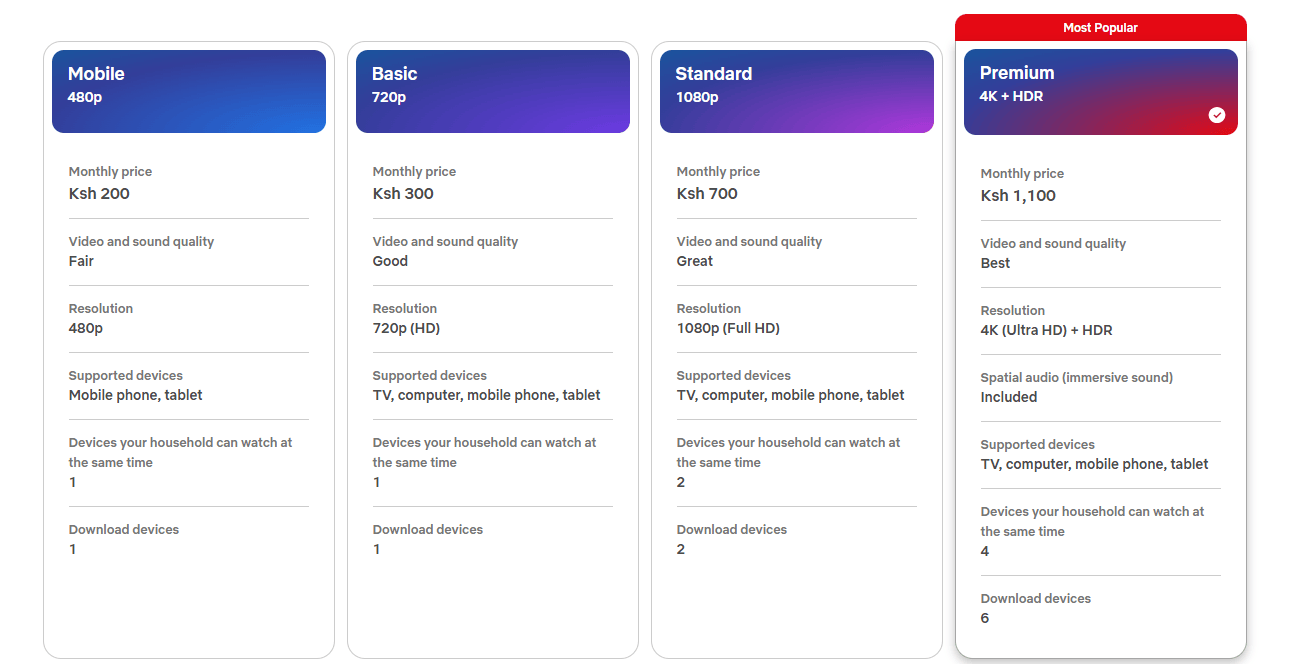
Netflix's Kenya pricing puts Citizen's fee in sharp relief. Netflix offers four local tiers: Mobile at KES 200, Basic at KES 300, Standard at KES 700, and Premium at KES 1,100. Citizen's KES 350 sits above both of Netflix's entry-level plans.
The comparison isn't exact, and RMS has a fair counterpoint. Netflix sells an on-demand entertainment library, whereas RMS is bundling three live broadcast stations, two of them vernacular. For a household that follows both Citizen and Inooro, the bundle offers more utility than a single-channel fee.
Even so, the bundle only works for viewers who actually want all three stations, and the core product remains the exact same free-to-air broadcast Citizen airs on terrestrial television. The KES 350 fee therefore prices mobile convenience—watching on a phone without a decoder or antenna—rather than exclusive programming. Worse, a broadcast simulcast still carries the station's commercial breaks inside the feed. Because YouTube channel memberships do not remove YouTube's own ads—ad-free viewing still requires a separate YouTube Premium subscription, while Premium Lite only trims ad frequency—paying members sit through broadcast commercials and, without Premium, YouTube ads on top. That thins the value proposition considerably.
Friction cuts the other way
The bigger threat to the paywall isn't price; it is payment friction. YouTube's Kenyan checkout does not support M-Pesa or Airtel Money. Memberships require a debit, credit, or virtual bank card and bill at international foreign exchange rates, meaning bank conversion charges can push the final debit above KES 350. RMS did not design that checkout, but it inherits its limits. In a market where mobile money is the default rail for small digital purchases, card-only billing filters out a large share of casual viewers before price even enters the conversation. Virtual cards from local banks and fintech apps help, but they add steps that a commuter trying to catch the 7pm bulletin is unlikely to tolerate.
The alternative requires no steps at all. As of November 4, 2026, vidIQ ranked KTN News Kenya second among Kenyan YouTube channels with 3.46 million subscribers and NTV Kenya fourth with 3.2 million, behind Citizen TV Kenya's 6.74 million. As long as those rivals keep their livestreams free, a viewer who hits Citizen's paywall is two taps away from another newsroom. Netflix can ask users to clear a payment hurdle because its catalogue is exclusive. A news broadcast covering the same daily events as every other station has no such lock on its audience.
The audience is the asset

Citizen's YouTube lead has been commanding, and that scale is what it sells. During President William Ruto's inauguration in September 2022, the Media Council of Kenya reported that Citizen TV's YouTube page averaged 232,387 viewers against 67,908 for NTV; Kenyans.co.ke separately tracked a Citizen peak of 296,961 viewers against NTV's 90,792.
That gap holds on ordinary evenings, too. During routine 7pm to 9pm bulletins, Citizen's public YouTube live counter regularly tops 70,000 concurrent viewers, while KTN and NTV typically hover between 8,000 and 12,000.
Concentrated reach matters commercially because it defends rate cards. Advertisers buying airtime and digital inventory pay for demonstrable scale, and a dominant concurrent audience is an easy number to put in a pitch deck. If a meaningful slice of free viewers drifts to competitors, Citizen's digital numbers shrink, rival numbers grow, and the leverage RMS carries into agency negotiations narrows.
There is a legitimate counterpoint here: YouTube is still a fraction of traditional television. A GeoPoll ranking reported by Kenyans.co.ke placed NTV, then Citizen's closest competitor, at 10.6 million linear TV viewers. Measured against an audience in the millions, a YouTube stream drawing tens or hundreds of thousands of viewers is secondary. If RMS believes its core advertising revenue is safely anchored in linear broadcast, it may see little commercial downside in testing how much of its YouTube following will pay.
The revenue arithmetic

The commercial logic for RMS is clearest on a spreadsheet. Third-party analytics from vidIQ estimate Citizen TV's total YouTube AdSense earnings at roughly $100,400 a month—covering the entire channel's catalogue, not just livestreams. At the KES 130-to-the-dollar rate implied by the membership pricing, that works out to about KES 13 million a month.
Replacing or matching that figure with memberships takes serious volume. YouTube pays creators 70% of membership revenue after applicable taxes and fees while covering payment processing costs. On KES 350, that leaves RMS roughly KES 245 per subscriber per month before local tax deductions. Matching KES 13 million requires about 53,000 paying members.
Against a base of 6.74 million subscribers, 53,000 is under 1%—a conversion rate that looks achievable on paper. Against roughly 70,000 concurrent prime-time viewers, however, it is a steep climb, even allowing that daily unique viewers outnumber any single live snapshot.
For the math to work, three things have to hold at once: membership income must add to rather than merely replace lost ad revenue; card-only checkout must not choke off willing subscribers; and rivals must fail to capture the viewers who walk away. Each assumption is plausible on its own. Together, they leave very little margin for error.
The real test ahead
With the rollout still fresh and RMS yet to release figures, the verdict will come down to three numbers over the coming weeks: how many viewers actually convert, how sharply Citizen's concurrent livestream counts dip, and whether KTN and NTV see a measurable bounce.
Right now, the odds look tough. The price is steep for a simulcast that still carries ads, the payment rail is narrow for Kenya's mobile-money economy, and free competitors are a click away. Citizen's brand is strong enough to defy conventional wisdom, and its free-to-air signal remains untouched for anyone in front of a television. Whether that same loyalty stretches to a KES 350 card charge on a smartphone is the gamble RMS has just placed.
Comments