 By
By 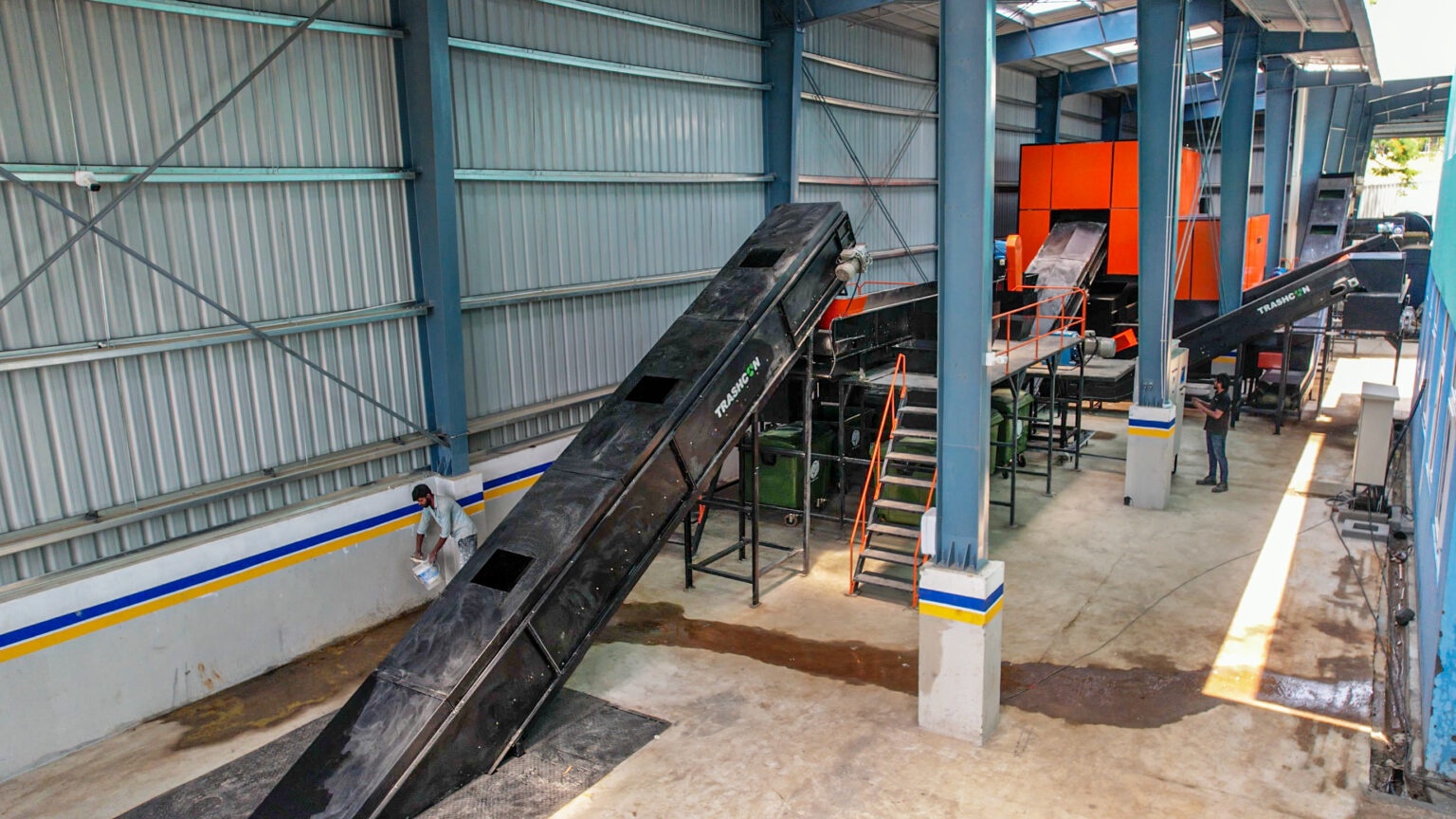
Every morning, an estimated 3,000 to 4,000 tonnes of waste is generated across Kenya. Half of it (roughly 1,500 to 2,000 tonnes) comes from Nairobi alone. A significant portion of that ends up at Dandora, the sprawling dumpsite in eastern Nairobi where mountains of mixed plastic, organic matter, metal, and paper stretch as far as the eye can see. The acrid smell of burning plastic hangs permanently in the air above communities that live alongside it, breathing its toxins, absorbing its health costs.
Into this reality, this week at the Kenya International Investment Conference, a machine was unveiled that its proponents say can fundamentally change how Kenya recovers value from waste. TrashBot, a decentralised automated waste segregation machine developed by Indian zero-waste enterprise TrashCon and being brought to Kenya through a partnership with local impact enterprise TakaTaka Ni Mali, represents Kenya's most concrete experiment yet with hardware-driven circular economy infrastructure.
The technology is real. The partnership is credible. The ambition is legitimate.
The harder question, the one that no press release answers, is whether an automated machine designed to sort waste is the right intervention for a country where waste sorting is already being done, informally, by hundreds of thousands of people whose livelihoods depend on it.
What TrashBot Actually Does
TrashBot is a decentralised waste segregation machine. Unlike large centralised sorting facilities that require waste to be collected, transported, and processed at a single location, TrashBot is designed to be deployed at the point of waste generation (apartment blocks, market areas, commercial premises, institutions) where it sorts mixed waste before it enters the collection chain.
The machine processes mixed waste through a combination of mechanical separation, sensor-based classification, and automated sorting arms that direct different material streams ( plastic, organic, metal, paper) into separate compartments. The result is pre-sorted waste that can be directed to the appropriate recycling or processing stream without the manual sorting step that currently happens either at collection points or at sites like Dandora itself.
TrashCon CEO and Founder Nivedha RM describes the machine as enabling counties to recover value from mixed waste and build more resilient waste systems. The partnership with TakaTaka Ni Mali ( which will act as the local reseller) was facilitated by TRANSFORM, an impact accelerator backed by Unilever, the UK government's FCDO, and EY.
The South-to-South transfer framing is deliberate. TrashCon has operational experience in India's waste management context, a country with its own complex informal waste ecosystem, rapidly urbanising cities, and policy environment that shares structural similarities with Kenya's. The lessons from India do not translate directly, but they translate more directly than lessons from European or North American waste management systems would.
The Scale of the Problem TrashBot Is Entering
To understand whether TrashBot can make a dent in Nairobi's waste crisis, you need to understand the scale of what it is up against.
Nairobi generates between 1,500 and 2,000 tonnes of waste daily. Of that, only a fraction is formally collected, and a smaller fraction still is recycled. The World Bank puts the figure at roughly 2,400 tonnes of solid waste generated in Nairobi per day, 20% of which is plastic. The Kenya Climate Innovation Centre CEO Joseph Murabula estimates the total waste market opportunity in Kenya at $54 billion, larger than agribusiness, renewable energy, water, and forestry combined.
Nairobi County launched a major citywide clean-up campaign in February 2026, framing it as the foundation of a new waste management architecture. County Executive Committee Member Maureen Njeri described plans for material recovery stations that would sort and repurpose waste, anchoring Nairobi's transition to a circular economy. The county's stated ambition is a waste-to-energy future, extracting value from garbage rather than simply moving it from street to dump.
TrashBot enters this environment at a moment when policy ambition and technological possibility are finally beginning to converge. That convergence is why this week's KIIC showcase matters beyond a product announcement.
The Economy That Already Exists in the Waste Stream
Here is what the technology optimists do not always say clearly: Kenya already has a waste sorting system. It is informal, unregulated, physically dangerous, and economically precarious but it functions, and it supports hundreds of thousands of livelihoods.
Waste pickers ( known locally as chifua or scavengers depending on the area) work at Dandora and similar sites across Kenya, manually sorting through mixed waste to extract recyclable materials: plastic bottles, metal scrap, cardboard, paper, glass. They sell these to middlemen and brokers who aggregate materials and sell to recyclers. The chain is long, the margins at the bottom are thin, and the health costs are enormous, workers burning plastic to stay warm, sleeping on landfill sites, developing respiratory conditions from sustained toxic exposure.
The Kenya National Waste Pickers Welfare Association exists precisely to give these workers a collective voice. Secretary General Gisore Nyabuti has articulated the core objective clearly: waste pickers want a dignified life, inclusion in the formal waste management value chain, and a path to economic stability rather than the volatile, hazardous informality they currently occupy.
The critical question any automated waste sorting technology must answer in Kenya is not whether it works technically. It is what happens to the people currently doing that work.
TRANSFORM (the accelerator that facilitated the TakaTaka Ni Mali and TrashCon partnership) has identified a partial answer. The framing in the partnership is that TrashBot helps sort smaller fragments of waste and low-value recyclables that cannot be manually recovered, material that currently ends up in the dump because no human picker can economically extract value from it. This positions TrashBot as complementary to informal waste picking rather than competitive with it: the machine handles what humans cannot, while humans continue handling what they can.
That is the right framing. Whether it holds in practice depends on deployment decisions that have not yet been made publicly. If TrashBot is deployed specifically at the point of waste generation ( apartment blocks, markets, offices ) before waste enters the collection chain, it adds a pre-sorting step that does not displace the manual sorting that happens downstream. If it is deployed at collection points or sorting facilities as a replacement for manual sorting labour, the displacement question becomes real and urgent.
The Ecosystem of Innovation Already in the Field
TrashBot is not entering a vacuum. Kenya already has a rich ecosystem of waste technology and circular economy innovation that any new entrant must fit into rather than overlay.
TakaTaka Solutions operates in the Nairobi Metropolitan Area, collecting waste from homes, businesses, and industrial facilities and sorting it at their own facilities into more than 40 material fractions, recycling 95% of what they collect. Plastic containers become flakes and pellets for local manufacturers. Organic waste becomes compost. Paper, cardboard, and glass go to specialist recyclers.
Taka Bank in Dandora takes a fundamentally different approach, community tokenisation. Residents bring recyclable waste to collection kiosks. Youth workers sort it into categories. The sorted waste is sold to recycling companies, and residents receive tokens redeemable for food, cooking fuel, rent, and school fees. It is a local currency backed by waste. The economic logic is elegant: it incentivises source separation at the household level, creates employment for youth sorters, and generates revenue for the Dandora community that produced the waste in the first place.
The T-Bin, developed by Kenyan inventor Eddy Gitonga, is a solar-powered smart waste bin that educates users on waste separation and provides free Wi-Fi as an incentive to sort correctly. Deployed at Juja City Mall in Kiambu, it has averaged 300 daily users and has measurably changed the waste composition of what that mall produces.
Kiambu County is piloting an AI-enabled cloud platform in partnership with De Graft Management Ltd. that automates the disposal, collection, and recycling workflow across tenants, landlords, and waste service providers, connecting stakeholders in a single platform and incentivising recycling through service charge discounts.
Each of these represents a different point of intervention in the same system: household source separation, collection efficiency, sorting automation, material recovery, economic incentivisation. A successful Nairobi waste management transformation needs all of these working in coordination, not competition.
What Success Actually Looks Like
The Nairobi waste crisis is not primarily a technology problem. It is a coordination problem, between counties and the national government, between formal and informal waste actors, between households generating waste and the infrastructure meant to handle it, and between the recycling industry's demand for clean material streams and the mixed-waste reality of what gets collected.
Technology interventions like TrashBot address the sorting stage of that coordination problem. They are valuable if (and only if) the other stages function well enough for clean sorted material to be worth producing. A well-sorted batch of plastic from a TrashBot machine has no value if no truck collects it, no recycler purchases it, and no policy framework incentivises the entire chain to function.
Kenya's new waste policy, which TRANSFORM specifically references as creating the context for the TrashCon partnership, provides the policy anchor. Nairobi County's waste-to-energy ambitions provide the infrastructure direction. The existing ecosystem of TakaTaka Solutions, Taka Bank, and grassroots waste picker organisations provides the human infrastructure.
TrashBot's contribution ( if the deployment is designed thoughtfully ) is to sort the material that human pickers cannot economically recover, increasing the total volume of recyclable material available to Kenya's recycling industry without displacing the informal economy that already extracts what it can.
That is a meaningful contribution to a $54 billion market opportunity. It is not, on its own, a solution to the Nairobi waste crisis. But solutions to the Nairobi waste crisis are not single interventions. They are ecosystems and TrashBot, positioned correctly, is a useful addition to one that is already more sophisticated than most global observers recognise.
The first TrashBot concept was showcased at the Kenya International Investment Conference waste management side event, March 25-27, 2026.
Comments