 By
By 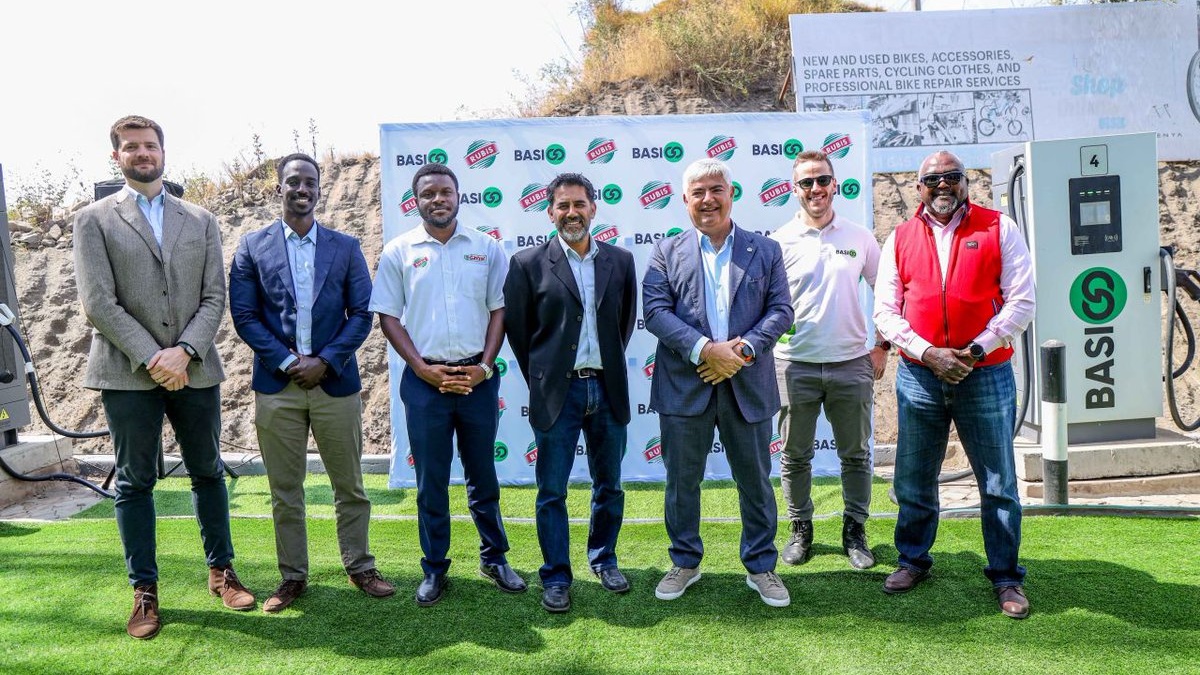
Kenya's electric vehicle infrastructure has been almost entirely confined to the capital since the industry took off. That changed this week. BasiGo, the country's leading electric bus maker, and Rubis Energy Kenya, a fuel retailer with more than 300 stations nationwide, have opened the first public fast-charging station outside Nairobi, with three more set to follow within days. For an industry whose growth has been capped by exactly this kind of infrastructure gap, the move signals that EV travel between Kenyan towns is becoming a practical option rather than a theoretical one.
BasiGo and Rubis Energy Kenya announced their partnership on Monday, July 20, to deploy fast-charging stations at Rubis service stations along Kenya's major transport corridors. Under the arrangement, BasiGo leases space at Rubis stations to install and operate the chargers.
The first site is already running at the Rubis Sabaki station in Athi River, Machakos County. Three more, in Meru, Nanyuki, and Nyeri, are scheduled to open by the end of July 2026. These will be the first public EV chargers located outside greater Nairobi.
Each station is equipped with 100kW DC fast chargers supporting both CCS2 and GB/T connector standards, the two main charging formats used by electric vehicles sold in Kenya. That dual compatibility means the stations can serve passenger cars, electric minibuses, vans, trucks, and BasiGo's electric buses at the same site.
At 100kW, the chargers can take a typical passenger EV from low charge to nearly full in under an hour. Charging is priced at an indicative rate of KES 48 per kWh, applied uniformly across all sites in the partnership.
Kenya's electric mobility sector has grown quickly by regional standards, but almost all of that growth has been concentrated in Nairobi. BasiGo's own charging depots, including sites in Embakasi, Buruburu, Komarock, Riruta, and Taj Mall, have historically clustered around the capital, where its electric bus fleet operates.
That concentration made sense while EV adoption was still limited to city routes. But it also meant that any vehicle attempting a longer journey, whether a private car heading to Nyeri or an intercity bus running to Meru, had no reliable way to recharge once it left Nairobi's boundaries. BasiGo has already tested this gap directly: the company ran a pilot program for intercity electric minibuses on routes connecting Nairobi with Thika, Nyeri, Nakuru, and Nyahururu earlier in 2025, a project that would have depended on exactly the kind of corridor charging now being installed.
Rather than building standalone charging sites from scratch, BasiGo is installing its equipment at existing Rubis fuel stations. This approach lowers the cost and speed of expansion considerably. Rubis already owns the land, the grid connections, and the customer traffic; BasiGo supplies the charging technology and operational expertise.
For Rubis, the deal fits a broader shift among fuel retailers who are looking to diversify as vehicle electrification advances. For BasiGo, it provides near-instant access to a nationwide footprint of more than 300 potential sites, a scale the company could not have matched by developing standalone stations on its own timeline.
Moses Nderitu, BasiGo's Managing Director for Kenya, framed the rollout as addressing the industry's remaining bottleneck: the technology to go electric already exists, and the outstanding question is whether charging infrastructure can keep pace with demand.
The BasiGo-Rubis rollout is part of a broader acceleration in Kenya's charging infrastructure. The Ministry of Energy and Petroleum has committed $47.26 million to build 10,000 EV charging stations nationally, with an initial phase targeting seventeen towns along major highways, including Voi, Naivasha, Nakuru, Eldoret, and Kisumu. Other operators are moving in parallel: Roam has placed roughly 3,500 electric motorbikes on Kenyan roads since 2017 and plans universal fast chargers in Machakos, Thika, Kiambu, and Kajiado in 2026, while Moja EV Kenya plans to add 100 more charging stations, many with 80-kilowatt DC units.
Much of this activity follows the same logic behind the BasiGo-Rubis deal: placing chargers at established fuel stations rather than building isolated sites, which keeps installation costs down and puts charging points along routes drivers already use.
The immediate test will be whether the Meru, Nanyuki, and Nyeri stations open on schedule this month, and whether usage from private car owners, not just BasiGo's own buses, justifies further expansion along the same corridors. BasiGo has signaled it intends to keep building beyond these four sites, and Rubis's 300-station network gives the partnership substantial room to grow if demand holds up.
The bigger question is grid capacity. As charging networks expand into county hubs, pressure is shifting from simply having enough stations to whether the underlying electricity grid can support them at scale, particularly during peak hours outside Nairobi. How that tension resolves will likely shape how fast intercity EV travel becomes a realistic option for ordinary Kenyan drivers, rather than an option limited to fleet operators like BasiGo.
Comments