 By
By 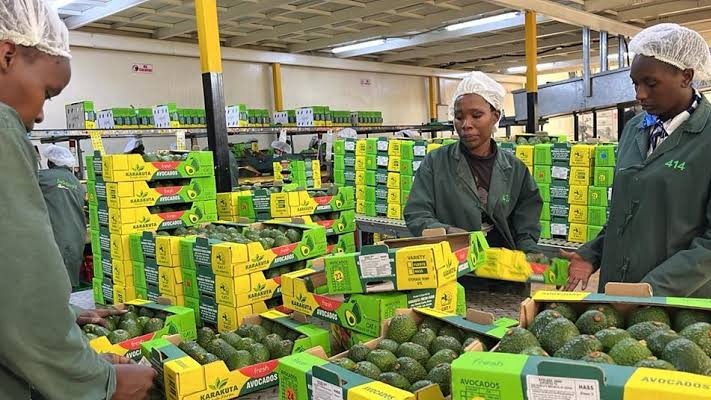
Karakuta Fresh Produce, a Juja-based exporter of Hass and Fuerte avocados and fresh herbs, has applied to list on the Nairobi Securities Exchange (NSE) by introduction. The filing would take a business that grew revenue 350% in 2025 into the public market at a difficult moment: the company's export volumes are down about 60% this year, and the NSE has just recorded the largest single-day loss in market value in its history.
The listing is subject to approval from the NSE and the Capital Markets Authority (CMA). The company is targeting a debut by the end of 2026. In a statement carried by Capital FM on September 17, founder and chief executive Grace Ngungi said the listing would give the company access to capital markets as it expands production and enters new export markets, and would let more investors, including smallholder farmers, take part in the avocado value chain.
What a listing by introduction involves
In a listing by introduction, a company's existing shares are admitted to trading on the exchange without an accompanying share sale. No new shares are issued and no fresh capital is raised on the day of debut. That separates it from an initial public offering (IPO), in which shares are sold to investors to raise funds shortly before listing.
Ngungi told Business Daily that the listing would give shareholders a transparent platform for price discovery and trading, strengthen corporate governance, and open access to deeper capital markets for possible fund raising in future. The company is expected to publish financial information and other disclosures before it lists.
Those disclosures have not yet been released. The public statements so far give growth rates rather than absolute revenue, profit, debt or a proposed valuation. Karakuta would add a seventh company to the NSE's agricultural segment, which currently has six members: Eaagads, Kakuzi, Kapchorua, Limuru Tea, Sasini and Williamson Tea Kenya.
From 20 acres to more than 180
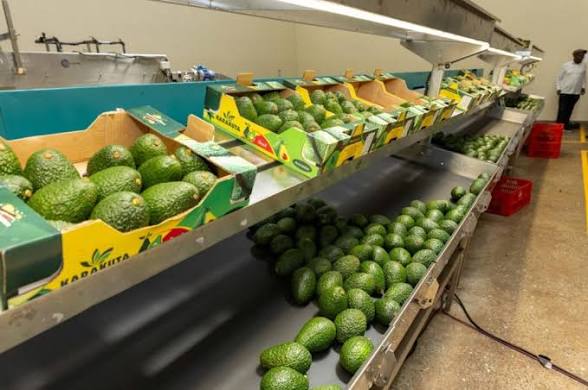
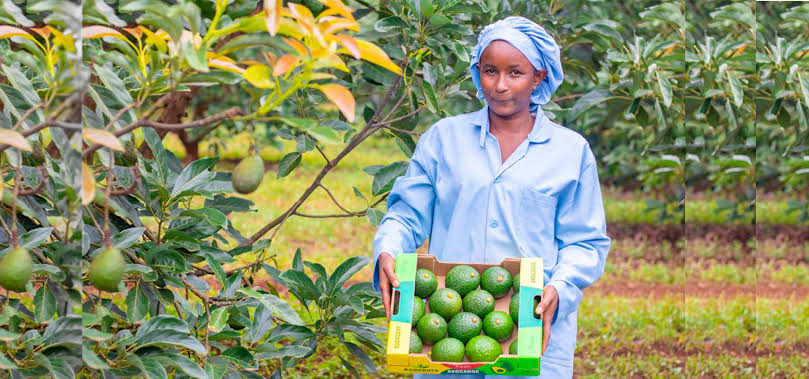
Karakuta was established in 2018. A profile published by the International Trade Centre (ITC) says the company has grown from 20 acres to more than 180 acres, and that its annual revenue rose 350% between 2024 and 2025. Its workforce expanded from seven staff to 82 permanent employees and 280 casual workers, with women making up 70% of the team. To manage the seasonality of avocado harvests, it also extended operations to Tanzania and Uganda, which lets it supply customers over a longer part of the year.
The farmer network has widened alongside the acreage. When the company commissioned its Nairobi packhouse in May 2025, Capital FM reported that it worked with more than 1,500 smallholder farmers across Kiambu, Nyeri, Kirinyaga and Meru counties. The company now says it sources from more than 3,000 farmers across Kenya, Uganda and Tanzania.
The packhouse has a stated capacity of 7,500 tonnes and includes a high-precision grading and packing line.
At the launch, Equity Group Managing Director James Mwangi credited Equity's financing, Israeli packing technology and a Spanish market that absorbs most of the company's fruit. Mwangi said Karakuta packed eight containers in its first harvest year and 18 in its second, and was projecting 60 containers for 2025.
The company ships to the European Union, the United Arab Emirates, Malaysia and India, and is seeking entry into China. It also exports herbs including basil, oregano, thyme, mint and rosemary. Fruitnet reported in July 2025 that Karakuta's exports to Asia and the UAE grew 30% that year as it moved toward markets with shorter transit times.
A tougher export season
The 2026 season has not followed the same trajectory. In an interview with Fruitnet in June, Ngungi said Karakuta's production rose 20% from 2025 on favourable rainfall and better orchard productivity, with full-year output expected to reach about 700 tonnes, up from 560 tonnes last year. Export volumes, however, were down roughly 60% compared with the same period in 2025.
Ngungi gave several reasons. The rains that lifted yields also delayed fruit maturity, so the main crop came in during May, later than usual. That put Kenyan exporters in direct competition with Peru during its peak. She said Peru was shipping around 1,000 containers a day in May, about 80% of them bound for Europe, which is also the main market for Kenyan avocados. The resulting supply pressure lowered prices.
Freight added a second layer of cost. Ngungi said the port of Jebel Ali in the UAE is no longer accessible because of security problems linked to the conflict in the region. Cargo for the Middle East is instead landed at Khor Fakkan and trucked to Jebel Ali, at roughly US$5,500 more per movement than in 2025. She also cited higher packaging, energy and agricultural input costs.
The company's experience mirrors wider industry conditions. A US Department of Agriculture Foreign Agricultural Service (FAS) report from its Nairobi office expected Kenya's 2025 avocado exports to fall to 121,000 tonnes despite record production, citing Red Sea disruptions and export controls imposed by the Agriculture and Food Authority. The same report forecast 2026 production of about 727,000 tonnes and exports of 130,000 tonnes, a 7.4% increase, while warning that rerouting around the Cape of Good Hope could nearly double transit times and make Kenyan fruit uncompetitive at destination. Fruitnet noted in April that the Gulf crisis could affect that forecast.
Globally, avocado supply is expanding. RaboResearch, cited by FreshFruitPortal in July, said global avocado exports have grown more than fourfold in 15 years, from about 730,000 tonnes in 2010 to a projected 3.8 million tonnes by 2029, and that competition sharpens when several producing regions overlap in the same destination markets.
Family Bank set the recent precedent
Karakuta would follow Family Bank, which listed on the NSE by introduction earlier this year. After CMA approval, the lender began trading on June 23, 2026, listing about 1.66 billion shares on the Main Investment Market Segment at an introduction price of KSh18. The price came from an independent valuation that tracked the bank's over-the-counter trading, where its shares had changed hands since 2006. That valued the bank at about KSh29.9 billion.
The first session was volatile. The stock touched KSh50 intraday before closing at KSh26, a 44% gain on the introduction price, on volume of 1,865,856 shares. The same outlet reported that the bank did not intend to raise funds through the transaction, having raised KSh8 billion in a private placement in 2025. This described it as the second NSE listing of 2026, after the Kenya Pipeline Company.
The market Karakuta would enter
Karakuta's filing became public in the same week the NSE suffered its worst day. On Wednesday, September 16, the exchange shed KSh139.63 billion (about US$1.08 billion) in market value. Total market capitalisation fell 3.38% to KSh3.987 trillion, dipping below KSh4 trillion for the first time since the exchange crossed that level in August.
The loss exceeded the three largest daily declines of the 2020 Covid-19 rout: KSh125 billion on March 9, KSh117.67 billion on March 12 and KSh116.35 billion on March 13. The comparison is in nominal shillings and does not adjust for the growth in the market since then.
The selling was broad. Forty-six stocks closed lower against nine gainers, with 16 unchanged. Co-operative Bank fell 7.32% to KSh33.55, KCB Group 6.39% to KSh84.25, Equity Group 5.41% to KSh96.25, Absa Bank Kenya 5.30% to KSh31.25 and Safaricom 3.84% to KSh35.10. Over Tuesday and Wednesday combined, Safaricom lost KSh52.1 billion in market value, Co-operative Bank KSh24.9 billion, Equity KSh21.7 billion, KCB KSh18.5 billion and Absa KSh16.3 billion. Melodie Ndanu, a research analyst at Standard Investment Bank, attributed the moves to investors locking in gains after a strong rally.
Global rates were part of the backdrop. The Kenyan Wallstreet reported that the US 10-year Treasury yield reached 5.041% on Tuesday, its highest since July 2007, while Germany's 10-year yield touched its highest since 2009. Higher yields on safer assets can reduce the relative appeal of frontier-market equities. Foreign investors had already recorded net NSE outflows of KSh1.6 billion in the first two weeks of September, and Business Daily put net foreign selling at KSh2 billion over the last three sessions. The US Federal Reserve then raised its benchmark rate by 25 basis points to a range of 3.75% to 4% on Wednesday, in a unanimous 12 to 0 vote and its first increase since 2023. The announcement came at 2 pm Eastern time, after the NSE had closed for the day.
The sell-off followed a strong year. Even after Wednesday, the NSE All Share Index was up 27.34% year to date and market capitalisation was up 35.41%, with 51 tracked counters higher for the year against 10 lower.
The weakness continued after Wednesday. The Central Bank of Kenya's weekly bulletin of September 18 showed market capitalisation falling from KSh4.154 trillion on September 10 to KSh3.948 trillion on September 17, a 4.96% decline. The NSE All Share Index dropped from 247.53 to 235.26 points over the same period, while equity turnover rose 44.75% to KSh9.27 billion as 178.71 million shares changed hands. Karakuta's application remains before the NSE and the CMA.
Comments